Let’s be real — most people are exhausted from giving their best hours away for a paycheck that barely keeps up. Earning money while you’re not actively working isn’t some pipe dream sold on late-night TV. It’s a real financial approach that millions of everyday Americans are using to quietly build wealth on their own […]
Let’s be real — most people are exhausted from giving their best hours away for a paycheck that barely keeps up. Earning money while you’re not actively working isn’t some pipe dream sold on late-night TV. It’s a real financial approach that millions of everyday Americans are using to quietly build wealth on their own schedule. Learning how to build passive income has moved well past buzzword territory by now. It’s a grounded, actionable decision — particularly when your job could disappear tomorrow, and your grocery bill keeps climbing anyway.
Whether you’re a freelancer patching together gigs, a parent at home with a couple of free hours carved out, or someone who simply wants another income lane without walking away from their current job, figuring out how to create passive income online has genuinely never been within reach like this before. The tools are there. The platforms are there. And honestly, the window of opportunity hasn’t been this wide in a long time.
This guide walks through seven tried-and-true strategies for building recurring income online — covering which platforms are worth your time, what pitfalls to sidestep, and how to stay consistent long enough to actually see the money come in.
A passive income stream is money that keeps coming in without you having to actively chase it, once the initial groundwork is out of the way. Active income means you stop earning the moment you stop working. Passive income doesn’t operate that way — it keeps ticking whether you’re heads-down at your desk, fast asleep, or killing a Tuesday afternoon on the couch with a film.
Getting that distinction straight is really the starting point for understanding how to build passive income the right way. Book royalties, affiliate commissions, blog ad revenue, stock dividends — these are the classics for a reason. The operative word, though, is after — because nothing worth having starts out passive.
A long-term approach to how to build passive income isn’t just picking a strategy and crossing your fingers. It’s about building a system that compounds. Here’s the framework that actually works:
Don’t scatter your energy across five ideas in month one. Pick one strategy, go deep, and get it generating something — even $50/month — before you add a second layer. Most people abandon passive income projects too early because they expect money faster than the model allows.
Whatever your passive income generates in the first 6 months, reinvest it. Better tools, better courses, better ad spend. The compounding effect of reinvesting early is what separates people who build real wealth from those who just dabble.
Set up a simple dashboard. Google Sheets works. Track your income sources weekly. Numbers tell you what your gut won’t — which streams are growing, which are stagnating, and where your next dollar should go.
Here are seven proven approaches for how to create passive income online — ranging from low-effort entry points to more involved long-term builds.
Blogging is not dead; it is growing and evolving. A blog built around one specific topic — personal finance, home improvement, pet care — can pull in recurring income through display ads, affiliate links, and sponsored content. Networks like Mediavine or Raptive pay based on how many eyes land on your pages. Put out 50–80 well-researched articles aimed at what people are actually searching for, let organic traffic find its way to you, and the ad revenue follows.
E-books, Canva templates, Excel spreadsheets, Lightroom presets — digital products don’t cost anything extra to duplicate and can sell without a ceiling. Gumroad and Etsy make it easy to get listed and start selling without a complicated setup.
Affiliate marketing is one of the more scalable ways to genuinely learn how to build passive income online. You point people toward products you believe in, drop your unique link, and collect a commission when they buy. Amazon Associates, ShareASale, and Impact are decent places to start. The money doesn’t come overnight, but as your content grows and your audience starts trusting your recommendations, the income builds on itself.
If you have expertise in marketing, cooking, coding, fitness, or anything, an online course is a one-time build that sells on autopilot. Teachable and Udemy provide the infrastructure. You build the content, and they handle payment processing, hosting, and delivery. A well-produced $97 course that sells 10 times a month is $970 recurring — without lifting a finger post-launch.
This one’s underrated. Paid surveys won’t replace your salary, but they’re a legitimate, zero-barrier entry point into how to create passive income online — especially if you’re just starting out. Spinzel’s paid surveys connect users with high-paying survey opportunities from reputable brands. Sign up, complete surveys in your spare time, and pocket real cash.
Want to start earning today with zero upfront investment? Check out Spinzel’s best paid surveys — one of the easiest ways to build supplemental income in under an hour a day.
If you already own creative assets, you can generate recurring income online for years. Photographers can upload to Shutterstock, Adobe Stock, or Getty Images. Musicians can license their tracks on Musicbed or Artlist. Every download earns a royalty — and old uploads can keep earning long after you’ve forgotten about them.
For those with capital to deploy, dividend stocks and Real Estate Investment Trusts (REITs) are textbook passive income. Platforms like Fundrise let you invest in real estate with as little as $10. Vanguard’s VYM ETF is a popular, diversified dividend option. This one requires money to make money — but done right, it’s the most truly “passive” of all strategies.
Automation is what turns a side hustle into a real income stream. These tools help you work smarter, not harder, when scaling how to build passive income long-term.
Automate your audience nurturing with email sequences. A subscriber who receives your emails on autopilot is far more likely to buy your digital product or click your affiliate link than a cold visitor.
Consistent social presence drives traffic to your income streams. Schedule your content for the week in one sitting using Buffer or Later. Done.
Track which content earns the most. Double down on it. Cut what doesn’t convert. Data removes the guesswork from income optimization.
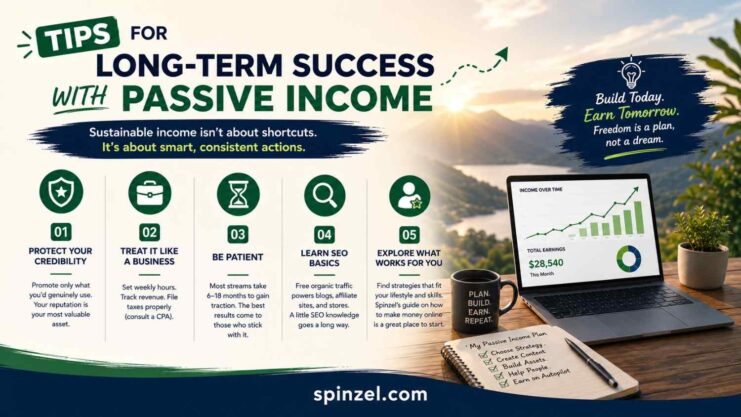
Building sustainable recurring income online isn’t about hacks. Here’s what actually keeps the engine running:
Conclusion
Here’s the bottom line: how to build passive income isn’t a secret. The knowledge is accessible. The platforms are available. The only real barrier is starting — and then not quitting when results take longer than expected.
Pick one strategy from this list. Go all in on it for 90 days. Whether it’s publishing digital products, building an affiliate content site, or starting with something as frictionless as paid surveys on Spinzel, the important thing is momentum. The income that you earn while you live your life is worth building. Start now, adjust as you go, and compound your results over time.
To build passive income, it takes 6–18 months to generate meaningful income. Paid surveys and affiliate marketing can produce smaller returns faster, while blogging and courses take longer to compound.
You can start with paid online surveys and affiliate marketing. These are the lowest-barrier initial points. You don’t need technical skills or an upfront investment to begin earning.
Many strategies — blogging, surveys, digital products — require little to no upfront capital. Dividend investing is the exception, where starting capital directly impacts returns.
Yes, but master one first. Running two or three streams simultaneously works well once you have systems in place — not while you’re still figuring out the basics.
Paid surveys won’t replace a salary, but they’re a legitimate, flexible supplement — especially on platforms like Spinzel that curate high-paying, reputable survey opportunities.