Introduction You don’t need a warehouse, bulk stock in a spare bedroom, or frantic post-office runs. Still, a working ecommerce business generating real money. That’s dropshipping done right. The global market has surpassed $300 billion, with a huge chunk going to solo operators running lean stores from laptops. Students are doing it between semesters. Freelancers […]
You don’t need a warehouse, bulk stock in a spare bedroom, or frantic post-office runs. Still, a working ecommerce business generating real money.
That’s dropshipping done right. The global market has surpassed $300 billion, with a huge chunk going to solo operators running lean stores from laptops. Students are doing it between semesters. Freelancers layer it on top of client work. People who got skeptical tried it anyway and understood it. The model works only when you approach it as a real business, not a vending machine.
This guide is the detailed version covering how to start dropshipping, what is actually important, and where people quietly go wrong.
Dropshipping is a fulfillment model where your store sells products you don’t physically own. Customer orders, you buy from the supplier at wholesale, and the supplier ships directly. Your profit is the spread.
No warehouse, upfront stock, or minimum order requirements.
It’s not a loophole. It is how much of ecommerce works behind the scenes. The model scales cleanly because adding products doesn’t mean renting more space. And starting an online store without inventory keeps your financial exposure low at launch compared to traditional retail.
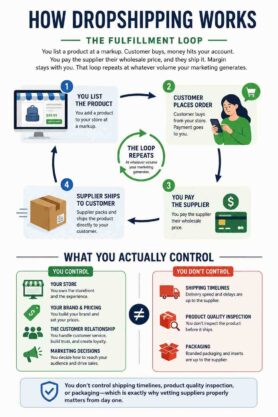
You list a product at a markup. Customer buys, money hits your account. You pay the supplier their wholesale price, and they ship it. Margin stays with you. That loop repeats at whatever volume your marketing generates.
Your store. Your brand. Pricing. The customer relationship. Marketing decisions. You don’t control shipping timelines, product quality inspection, or packaging—which is exactly why vetting suppliers properly matters from day one.
Multiple categories under one roof. Good for rapid product testing, but harder to build brand loyalty. Treat it like a testing lab.
One focused category—minimalist desk setups, eco-friendly kitchen gear, apartment dog products. Easier to market, stronger repeat purchase potential. This is where most people who actually make money with dropshipping end up landing.
Platforms like Printful let you sell custom-designed products—apparel, mugs, prints—with zero inventory held. Order comes in, they print and ship. Thinner margins, but real brand-building potential, especially for designers and creators.
Working with suppliers who white-label products under your brand. More upfront investment, considerably better positioning. Not a beginner play—a clear growth path.
The startup math is what draws people in. When working out how to start a dropshipping business with no money, a Shopify plan, a domain, and a small ad budget can get a store live for under $200. Traditional retail with minimum order quantities doesn’t come close.
Beyond that, location is irrelevant. A product pivot costs a few listing changes, not a warehouse reorder. Niche testing is cheap. The flexibility makes dropshipping one of the more forgiving ecommerce business ideas for people still learning.
Worth being straight about this.
Margins are thinner than most guides advertise. Without bulk pricing, per-unit costs are higher, and competitors often use identical suppliers. Differentiation has to come from brand, copy, and customer experience, because the product itself isn’t unique.
Supplier dependency is the other real friction point. Delays, quality issues, stockouts—those land in your inbox regardless of who caused them. Manageable, but only if you treat supplier relationships seriously rather than as interchangeable.
Building a store takes time. Earn while you’re at it. Spinzel’s Best Paid Surveys pays you for opinions while your business finds its footing.
Skip whatever’s trending this week. Look for categories with steady year-round demand and a clear buyer. Google Trends and Exploding Topics are practical—use them before committing.
Order samples. Check fulfillment timelines. Read platform reviews. AliExpress is the most common starting point; Spocket and CJ Dropshipping offer faster US/EU shipping that customers actually notice.
Shopify is the standard recommendation—the app ecosystem alone covers most dropshipping functions. WooCommerce works for WordPress users who want no monthly platform fee. Either way: clean, fast, and product-focused converts better than flashy and cluttered.
DSers and AutoDS handle the importing. But supplier copy reads like supplier copy. Rewrite every description. Customers notice the difference, even if they can’t name it.
A working starting formula: supplier cost × 2.5 to 3. Covers platform fees, payment processing, ad spend, and leaves room for profit. Adjust as your actual cost per acquisition becomes clear.
A live store isn’t a marketing plan. Pick one or two channels and commit. Paid ads for faster data. Organic social for lower cost and slower burn. SEO compounds over time. Pick the fit for your situation, not the one that sounds most exciting.
After 30–60 days, data tells you what to do—which products convert, which ads drain money, which pages lose buyers halfway. Follow numbers, not instincts.
Traffic is the job. Everything else is infrastructure.
Facebook and Instagram remain the standard for product discovery—especially visual, lifestyle items. Start at $10–$20/day, test at least three creatives per product, and cut anything that doesn’t show traction within five days. TikTok Ads have earned real attention for short demo products. Google Shopping catches buyers already searching—higher intent, cleaner conversion, but requires patience on setup.
A single well-made TikTok showing a product in a real context can outperform weeks of paid spend. Post consistently, stay niche-focused, and engage like a person. SEO is slower but it compounds—write descriptions that answer real search intent, chase keywords larger competitors ignore. Klaviyo handles email automation that recovers abandoned carts and re-engages lapsed buyers without manual effort.
“Could sell” isn’t a strategy. Check search volume, competitive landscape, and actual buyer intent before committing.
Cheap products from unvetted suppliers create expensive customer service problems downstream. Always sample first.
Profitable at $20/day doesn’t mean profitable at $200/day. Confirm your margins hold before pushing spend up.
Your store creates a brand impression before anything else. A default, unoptimized storefront doesn’t build trust with new visitors.
Income doesn’t have to wait while your store grows. Know Spinzel’s Online Paid Surveys and get paid for sharing your opinions.
Dropshipping works—genuinely, for people treating it as a real business. The model removes the biggest barrier to ecommerce: upfront inventory cost. That’s valuable. It doesn’t, however, remove the need for a sound niche, disciplined marketing, and consistent iteration.
The operators making real money with dropshipping aren’t coasting on a clever setup. They research thoroughly, build actual brands, and obsess over the customer experience enough to earn repeat buyers. Start focused. One niche, one platform, one traffic channel. Learn that before expanding. The business scales when the foundation holds.
Want to explore more income strategies while you build? Check out how to make money online with Spinzel’s full guide.
1. How much does it cost to start a dropshipping business?
Most people launch with a $100–$300 Shopify plan, domain, and small ad tests. No inventory purchase required upfront.
2. Can I start dropshipping with zero money?
Nearly. A Shopify free trial plus organic TikTok content can produce first sales before spending anything on paid ads.
3. How long before dropshipping becomes profitable?
Realistically, 30–90 days with consistent effort. Niche selection and ad efficiency are the biggest variables.
4. Is dropshipping a legal business model?
Fully legal and widely practiced. Run it transparently—real shipping estimates, honest return policies, responsive support.
5. What dropshipping products sell well in 2026?
Home organization, pet accessories, fitness gear, eco-friendly kitchen goods, and visually compelling tech gadgets consistently perform.