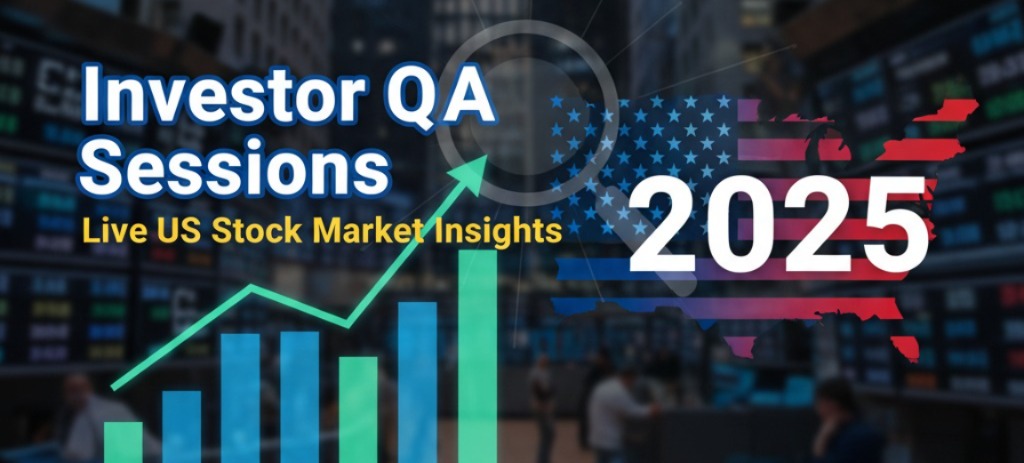
The US stock market dynamics may not be easy to understand, but it may become easier to navigate with the necessary guidance. Economic indicators, company earnings, and global events are ever evolving and also have a major effect on the prices of stocks. That is where investor Q&A sessions come into the picture, providing real-time information from the experts.
These sessions enable the investors to clear their doubts, obtain practical advice, and develop confidence in their strategies. Whether you are a novice or seasoned investor, these question-answer sessions can be of great help when looking to invest in the stock market. This blog will discuss the advantages of these sessions, general areas discussed, and how to get the most out of them.
Advantages of Attending Live Investment Question-Answer Sessions
Live Q&A sessions have special benefits that cannot be found in static articles or pre-recorded videos. The following are the main advantages for investors to attend an investor Q&A session:
1. Real-Time Clarifications
Q&A sessions are unlike webinars or recorded tutorials, as in the former, you can get answers to your particular questions. You get answers to all the questions, be it regarding the interpretation of the latest Federal Reserve policy impact or the analysis of the earnings reports. Real-time knowledge of experts clears the confusion immediately.
2. Expert Opinions
Analysts, fund managers, or financial educators who have years of experience in the market usually host these sessions. By learning through their insights, you can see opportunities and risks not just in general news headlines.
3. Update Market Strategy
Analysts talk about the recent trends in the market, the performance of the sectors, and the macroeconomic indicators. They also offer strategies that are in line with the current trends in the market. This is important in the sense that it is possible to dynamically manage your portfolio instead of using outdated strategies.
4. Improved Decision-Making
The interactive sessions help in confirming your assumptions or ideas. This eliminates second-guessing prior to making trades or investing. Portfolio performance can be enhanced a lot with confidence achieved by data-based professional guidance.
5. Networking Opportunities
Most of the live Q&A sessions provide chat rooms or community forums where you can interact with other investors. Exchange of views and experience creates learning networks that are useful in long-term investing.
Typical US Stock Market Question and Answer Sessions
The Q&A sessions in the US stock market address investors of different interests and experience. Some of the common topics of discussion are as follows:
1. Market Outlook and Macro-economic Trends
In live investor Q&A sessions, experts discuss broader economic indicators like interest rates, inflation, and GDP growth. These factors are analyzed to determine how they affect the overall market direction and sector performance.
2. Analysis of Earnings Reports
The question that the participants often ask is how to interpret the quarterly earnings results, revenue forecasts, and company guidance. This is particularly in the peak earnings season when the financial statements of major US companies are released.
3. Sector-Specific Insights
Sessions can be sector-specific, such as technology, healthcare, energy, or financials. Analysts study new trends, new regulations, evolving trends, and best-performing stocks in each industry to advise on investment.
4. Stock Picking Strategies
A large number of investors want to know how to find undervalued stocks or learn about the difference between growth and value investing. Many investors also want to know how to use the dividend investing techniques to accumulate wealth in the long run.
5. International Investor Taxation in the US
Foreign investors are always interested in taxation, withholding taxes on dividends in the US, and how to repatriate the profits without violating the rules of the IRS.
How Experts Answer Complex Investment Queries?
The questions asked during investment Q&A are usually technical in nature. Here is how the professionals usually answer these complicated questions:
1. Decoding Jargon
Analysts break down technical words and financial terminologies into understandable language that can be related to various people. As an example, when describing quantitative easing, they explain how it affects liquidity, interest rates, and stock valuation in a practical way.
2. Data-Driven Analysis
Experts refer to current market data, financial models, and case studies to justify their responses. When speaking about the PE ratio of Tesla or the free cash flow of Apple, analysts combine recent data to offer a sensible analysis.
3. Scenario-Based Explanations
In order to explain risks and opportunities, experts provide hypothetical situations. As an illustration, when speaking about a possible Fed rate increase, they describe likely sectoral effects depending on the assumptions of economic growth.
4. Applying Theory to Actual Markets
Experts relate the financial theory of academia to the real market behaviour. This is so that concepts such as beta, alpha, or market efficiency can be understood by using examples of the live market and the latest stock performances.
5. Promoting Free Thinking
Rather than providing direct buy/sell recommendations, respected analysts teach investors to learn about the factors and models underlying a situation. This way, investors feel confident in making their own judgment about future opportunities.
Top 5 Sites that Host US Stock Investor Q&A Sessions
These are the most popular sites where you can find interactive investor question and answer sessions for both beginners and experienced traders:
1. Seeking Alpha Premium Webinars
Seeking Alpha is one of the most popular sites that offers detailed stock analysis and crowd-sourced analysis. It frequently hosts live webinars for premium members. These events cover earnings reports, market outlooks, sector trends, and questions submitted by users, answered by analysts and professional investors.
2. Motley Fool Live
Motley Fool provides a program called Motley Fool Live, where analysts talk about trending stocks, respond to the inquiries of members, and explain complicated financial issues. Topics covered in sessions are the earnings call, portfolio allocation strategies, and long-term investment frameworks.
3. CNBC Pro Talks
CNBC Pro provides unique Pro Talks, during which Wall Street strategists, fund managers, and CEOs respond to user questions about market trends, valuations, and individual US-listed stocks. Such live shows offer more information than what is aired on the open media.
4. Webcasts by TD Ameritrade
TD Ameritrade has a wide variety of educational webcasts, some of which are interactive Q&A webcasts on US equities, technical analysis, and options strategies. The sessions will include beginner information on investing, to advanced trading setups with live charting demonstrations.
5. Events at Fidelity Learning Center
The Fidelity Learning Center features live events with Fidelity analysts and guest experts, specifically on market updates, economic outlooks, and retirement investing. The participants are allowed to ask real-time questions, and this allows personalised learning during each session.
Tips to Make the Most of Live Investor Q&A Sessions
One of the most effective methods of developing market knowledge is by taking part in live investor Q&A sessions. These are 10 tips you can follow to get the most out of each session:
- Research about the Speaker: Learn about the background of the speaker hosting or the guest expert. Being aware of their specialty will assist you in asking them questions that are pertinent to their field.
- Ask Clear, Concise Questions: Before the session, write down clear and concise questions. An example is: rather than asking, What stocks should I buy, ask, What are some of the important valuation measures to analyse small-cap tech stocks in 2025?
- Join Sessions Early: Attending a few minutes before the start of a session allows you to hear any initial comments. It also reserves your place in sessions where the number of attendees is limited.
- Stay Updated with Market News: Go through the headlines to match your queries with what is happening in the market before the session. Sites such as CNBC Markets give fast pre-session information.
- Participate in the Chat: In case the session is equipped with a chat box, participate with brief remarks or associated questions. Do not spam irrelevant views, since hosts tend to value appropriate and properly formulated audience feedback.
- Record Detailed Notes: Note down important points, stock tickers referred to, and strategic points made by the expert. Going through these notes afterwards helps in consolidating the learning process and helps you to implement it better in your portfolio.
- Learn Jargon in the Session: Do not be afraid to request an explanation of financial jargon or technical terms. As an example, when an analyst says that there is a compression of the PEG ratio, ask them to explain briefly to better understand.
- Follow-up Post-Session: Send follow-up questions or connect with the speakers on LinkedIn to learn more. Most hosts post slides or a summary of their sessions later to review in depth.
- Review Session Replays: Watching the recorded Q&A sessions again enables you to pick the parts you could not see the first time. Replays are stored in most of the learning centres, such as Motley Fool Live or Fidelity.
- Put Learning into Practice: Use the acquired knowledge in your portfolio research process. As an example, in case you have learned about sector rotation strategies, analyse your existing holdings to see where you can rebalance.
Limitations of Using Q&A Sessions to Make Investment Decisions
Although live Q&A sessions are great learning tools, relying solely on them to form portfolio decisions is inherently risky. The major limitations to remember are the following:
- Inadequacy of Personalised Financial Advice: The majority of Q&A sessions are general in nature and do not give specific recommendations depending on your unique financial objectives, risk profile, or time frame.
- Shallow Responses: Time pressure and the broad scope of questions that can be asked by the audience make professionals give only short overviews instead of in-depth analyses. This may create a lack of knowledge in key financial fundamentals.
- Information Overload Possibilities: Beginners may be overwhelmed by sessions on several market trends, sectors, and stocks. It is difficult to distinguish actionable insights and market commentary without structured follow-up research.
- Prejudice on Trending Topics: Analysts usually concentrate on trending stocks, industries, or stock market news to attract attention. This causes an information bias, ignoring less well-known opportunities or basic analysis of undervalued companies not in the limelight.
After reviewing the live Q&A insights, you may read the detailed article to test your understanding of the US stock market with the interactive polls and quizzes.
Conclusion
Q&A sessions with live investors are a great opportunity to keep up with the market trends, get new information from those who have already done it, and clear up the confusion on the spot. They give you a learning platform that is interactive and improves your understanding of the US stock market beyond the textbooks and the stagnant research reports.
A combination of Q&A knowledge with an in-depth financial analysis, portfolio review, and advice from licensed advisors will keep your strategies in line with personal objectives and market conditions.
FAQs about Investor Q&A Sessions
1. Are investor Q&A sessions suitable for absolute beginners?
Yes, most platforms have introductory sessions on the basics of the market, important terminologies, and investing models. This is why they are suitable for individuals who are still new to investing.
2. Do I need a paid subscription to access live US stock Q&A sessions?
Certain websites, such as CNBC Pro, Motley Fool Premium, and Seeking Alpha, are subscription-based, whereas brokers such as TD Ameritrade and Fidelity have free sessions available to account holders.
3. How often should I attend an investor Q&A session to stay updated?
One session a week should be enough to keep you informed about the market trends, new strategies, and industry-specific information that should be used in your portfolio.
4. Can I ask questions anonymously in these sessions?
Yes, in most platforms, it is possible to ask questions anonymously, particularly when the webinar is big, and you can clear your doubts without revealing your personal identity to the audience.
5. Do Q&A sessions discuss small-cap or penny stocks?
Some sessions may discuss trending small-cap stocks, but a discussion of mid-to-large-cap companies may take place because they are of greater interest to the market and have more research available.