Introduction We have watched smart, capable professionals get blindsided — not because they lacked talent, but because every dollar they earned came from exactly one place. One client. One salary. One platform. And when that one thing wobbled, everything wobbled with it. That’s the real problem with relying on a single income. It’s not just […]
We have watched smart, capable professionals get blindsided — not because they lacked talent, but because every dollar they earned came from exactly one place. One client. One salary. One platform. And when that one thing wobbled, everything wobbled with it.
That’s the real problem with relying on a single income. It’s not just financial risk. It’s the kind of stress that quietly eats into your judgment, your confidence, your ability to walk away from bad deals. Building multiple streams of income — especially online — fixes that. Not overnight. Not without effort. But it fixes it.
Here’s what we want to walk you through: the why (which most people actually underestimate), the how (which most people overcomplicate), and the what — the actual income diversification ideas and tools worth your time. If you’re in marketing, content, or business strategy, this is already closer to your skill set than you realize.
Here’s something worth saying plainly: income diversification isn’t a “nice to have” for people with spare time. It’s a decision that serious professionals make — often after one too many close calls with a volatile market, a client who disappeared, or a platform that changed its algorithm overnight and took their revenue with it.
Multiple streams of income online reduce your dependency on any one variable outside your control. That’s not pessimism. That’s just good strategy.
The wealthiest professionals and enterprises have always practiced income diversification ideas — that’s not new. What has changed is access. Today, a content strategist with a newsletter, a framework to sell, and one affiliate partnership is operating a genuinely diversified income portfolio. No venture capital needed. No office required.
What that creates financially:
This one doesn’t get talked about enough. When your income isn’t all riding on one relationship or one employer, something changes in how you carry yourself. You say no to bad projects, raise your rates, and you stop checking Slack at 11 pm because you have to. That kind of clarity — knowing you’re not one email away from financial panic — makes you better at everything, including your primary work.
Not every stream is the same, and that matters more than people realize when they’re starting out. Some will pay you this week. Others won’t pay you for six months. Mixing them wisely is what makes the whole thing sustainable.
These run on your direct time and attention — but they’re also the fastest to get off the ground:
These take longer to build — but they’re the ones that eventually run without you:
Want a fast, no-friction income stream you can start today? Browse verified paid surveys on Spinzel. No special skills, no setup, just your time and opinions.
Most people get stuck here — not because the options are unclear, but because there are too many of them. So they either pick five things at once and do all of them poorly, or they research endlessly and start nothing. Neither works.
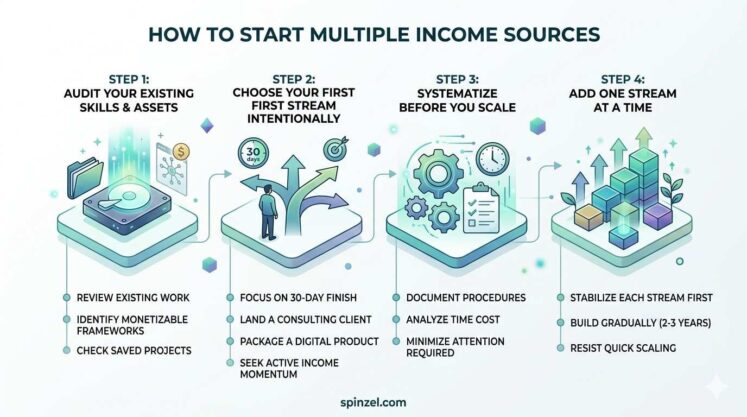
Before you go looking for new income ideas, go looking through your own work. Seriously — open your hard drive, your old client projects, your saved documents. What have you built that someone else would pay for? A lot of professionals have a genuinely monetizable framework or template sitting in a folder they haven’t opened in a year.
The question of how you can create multiple streams of income is not about “what is the best option?” — it’s “what can I actually start and finish in the next 30 days?” For most professionals in business or marketing, who pick down to two factual choices:
Don’t romanticize passive income at this stage. It’s real, but it requires months of upfront work before any money shows up. Active income gives you momentum, proof of concept, and cash you can actually use to fund the next thing.
This is where most people skip ahead and regret it. Once a stream starts producing — even $500/month — the instinct is to add another one immediately. Resist that. Document what you’re doing, figure out how much time it actually costs, and decide if it can run with less of your attention before you layer in more complexity.
One more stream. Then stabilize. Then one more. That’s it. Professionals who successfully run five or six multiple streams of income online didn’t build them in a quarter — it usually took two to three years. The pace feels slow. The results don’t.
Already busy but want an easy income add-on? Spinzel’s paid online surveys fit into gaps in your day — a commute, a lunch break, a slow afternoon.
Here’s the part nobody really covers at the “passive income” stage of most blogs: managing multiple income sources is genuinely hard without a system. Things fall through cracks. You forgot to invoice. Tax season becomes a nightmare. Your “side income” starts costing more time than your main job.
The fix isn’t working harder — it’s getting the structure right, early.
Some professionals carve their week by channel — certain days for primary work, one afternoon blocked for consulting calls, a standing slot for content. The specifics matter less than the principle: every income stream needs protected time, or it will always get bumped by whatever feels urgent that day.
Even a $200/month affiliate channel deserves a simple profit-and-loss view. What does it cost you in time? What does it return? Is it growing or flat? This kind of discipline makes it much easier to decide what deserves more investment — and what should just be quietly shut down.
A digital course pulling $3,000/month with four hours of maintenance is not in the same category as a freelance project taking 20 hours for $1,500. Once you have actual numbers, the scaling decisions get obvious. Put energy where the return is disproportionate to the effort.
Running multiple income sources without the right tools is the fastest way to feel constantly behind. These are worth setting up early — before you think you need them:
There’s no perfect moment to start building multiple streams of income. There’s also no version of this where it happens without intentional effort upfront. What the professionals who’ve actually done it will tell you — even those who started modestly — is that the biggest change wasn’t the money. It was how they started making decisions. Fewer out of fear. More out of choice.
That’s the real return on income diversification. Not just the extra cash. The options it creates.
Start with one stream. Run it until it’s stable. Build the next one deliberately. Use the tools. Track what the numbers actually say. And don’t let the pursuit of the perfect strategy become the reason you never start.
Before you close this tab:
1. How many income streams should I have?
Three to five is a commonly cited range. But one stable stream beats five unstable ones every time. Start there.
2. Can I build multiple streams of income while working full-time?
Yes. Especially with low-time options like digital products, paid surveys, or affiliate content.
3. How long until multiple income streams actually pay off?
Active streams can earn within weeks. Passive ones typically take six to twelve months minimum.
4. What are the best multiple streams of income online for beginners?
Freelancing, paid surveys, and one digital product are the most realistic starting points for most professionals.
5. Do I have to pay taxes on income from multiple sources?
Yes, all of it. Use QuickBooks or Wave from the beginning so tax season isn’t a crisis.
6. Are paid surveys worth it as an income stream?
For low-effort supplemental income, yes. Spinzel lists verified options that actually pay fairly.
7. What kills most multi-income attempts early on?
Starting too many streams at once and finishing none of them. Sequence matters more than speed.