If you earn money from online surveys, you may have a question about whether the IRS expects a cut. Yes, you pay taxes on survey income. Money earned from surveys is taxable in the United States. Even when a platform never sends you a tax form and even when the amount feels too small to […]
If you earn money from online surveys, you may have a question about whether the IRS expects a cut. Yes, you pay taxes on survey income.
Money earned from surveys is taxable in the United States. Even when a platform never sends you a tax form and even when the amount feels too small to matter.
More importantly, how you report your income or whether you owe anything over regular income may also impact taxation.
In this guide, we will cover essential details like when survey income is taxable, which forms you might receive, the 2026 reporting thresholds, and the process to report it correctly.
Yes, paid surveys are taxable. The IRS treats your survey earnings as taxable income, just like wages, freelance pay, or interest.
This applies whether you cash out via PayPal, bank transfer, or gift card. Non-cash rewards are still taxable. If a survey pays you a $25 Amazon gift card, the IRS views that $25 as income at its face value. Survey money is taxable no matter how you are paid. For your return, what counts is the total you earned across every platform and how you report it.
All of it. No amount of survey income is tax-free.
There’s no general “under $400 = tax-free” rule. The $400 figure is bound specifically to self-employment tax. Whether you earned $20 or $2,000 this year, you must report your total earnings.
Survey earnings change widely by platform, profile, and how many surveys you qualify for, so two people can report very different totals.
For realistic numbers before you start, see how much paid surveys actually pay.
Some survey sites issue tax forms when your earnings reach the required reporting threshold, while others may not. If you earn enough, a survey platform may send you a 1099-NEC or 1099-MISC reporting your payments.
If you earn a smaller amount, you may not receive a tax form. However, not receiving a 1099 does not automatically mean the income is tax-free or that you can ignore it.
There is also a separate rule for payment apps such as PayPal. Depending on your transactions and the applicable reporting rules, the payment processor may issue a 1099-K. If you receive a tax form, make sure the income reported on it is included correctly on your tax return.
These thresholds decide when a platform must send a form. They do not decide whether you owe tax. Two forms matter for survey income:
| Form | Who issues it | Reporting threshold |
| 1099-NEC or 1099-MISC | The survey site paying you | $600 for 2025 earnings; $2,000 for 2026 and later |
| 1099-K | Payment processor, such as PayPal | Over $20,000 and 200+ transactions |
A few states set lower 1099-K thresholds than the federal rule, so you might receive a form even with modest earnings depending on where you live. The One Big Beautiful Bill Act reset the federal 1099-K threshold to its pre-2022 level after several years of planned lower limits.
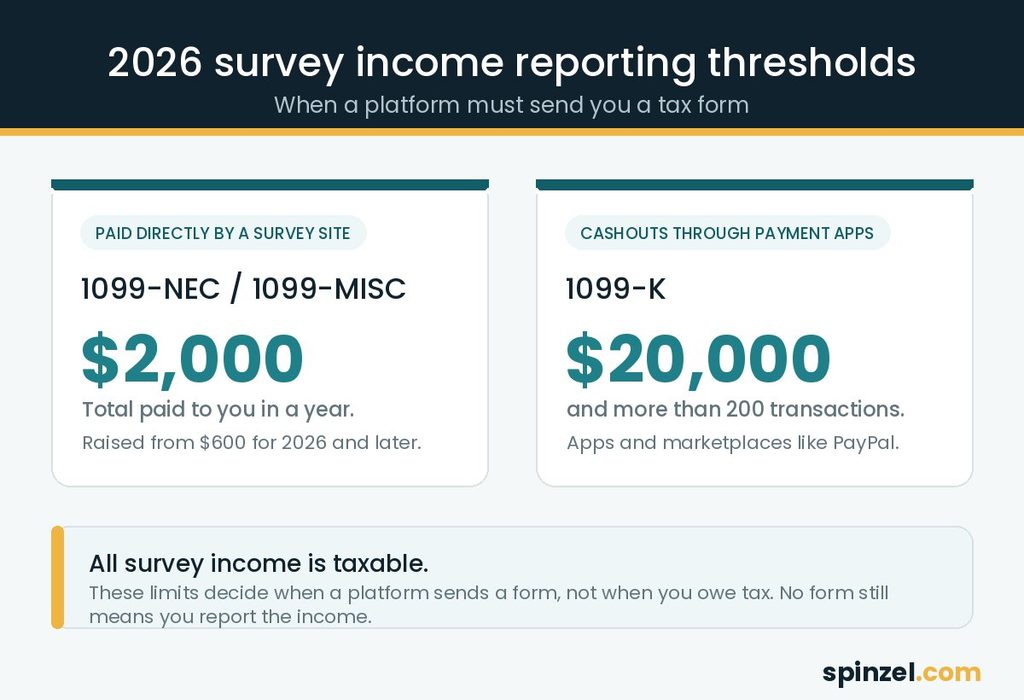
Not receiving a form doesn’t erase the tax. The reporting thresholds are the platform’s filing duty, not your personal cutoff. If you earned $150 from three survey sites and none sent a 1099, that $150 is still reportable income.
The IRS expects you to report all income, down to small cashouts and gift card rewards. Keeping your own records matters here, because you can’t rely on a form arriving to tell you the number.
Spinzel lists paid survey sites with their payout terms and cashout minimums, so you can track what you earn from the first cashout. Browse paid surveys on Spinzel to see how different platforms pay and which ones report earnings.
This depends on how you take surveys. For casual earners, survey income is usually hobby income. Hobby income is subject to regular income tax but not self-employment tax, so you avoid the extra 15.3% that covers Social Security and Medicare.
If you take surveys regularly and run it like a business, with the intent to profit, the IRS can treat it as self-employment. Once your net earnings cross the $400 threshold, the IRS requires you to file Schedule SE and pay self-employment tax.
The line between a hobby and a business comes down to profit motive, consistency, and whether you keep business-like records. For someone filling spare minutes with surveys, hobby treatment is the usual outcome.
Knowing how to report survey income on taxes comes down to which category you fall into: hobby or business.
Reporting survey income as a hobby
Report the total on Schedule 1 (Form 1040), line 8j, listed under activity not engaged in for profit. That amount flows to your Form 1040 and is taxed at your regular rate. You report the income but can’t subtract expenses from it.
Reporting survey income as a business
File a Schedule C listing your earnings and any related expenses, then carry the net profit to Schedule 1. If your net is $400 or more, calculate self-employment tax on Schedule SE. Report earnings from every platform, not just the amounts on forms you received.
For hobby income, no. Under current rules, you can’t deduct expenses against hobby earnings, so the full amount you report is taxed. If your survey activity qualifies as a business and you file Schedule C, you can deduct ordinary and necessary costs tied to it, such as a portion of your internet bill.
For the typical survey taker, there is little to deduct anyway, since the activity needs almost no equipment or spending.
Good records make tax time simple, especially when no forms arrive. Keep track of:
The IRS generally advises keeping tax records for at least three years. A running total across every platform also makes it easier to report the right number instead of guessing.
Survey income is treated like any other money you earn. It’s taxable, and you report it, even the small cashouts.
For casual earners, that usually means adding a line to Schedule 1 and paying regular income tax, with no self-employment tax to worry about.
For heavier users running surveys as a business, Schedule C and self-employment tax apply. The safer approach is to record what you earn across every platform and report the full amount, whether or not a form shows up.
This guide is general information, not tax advice, so confirm your own situation with a tax professional or the IRS.
Yes, you pay taxes on survey income, and reporting it correctly is straightforward once you know which category you fall into. To estimate what you might make this year, Spinzel’s survey earnings calculator turns time spent and typical payouts into a realistic number, which also helps you plan for tax season.
Do you have to pay taxes on survey money under $600?
Yes. All survey earnings are taxable income, regardless of amount. The $600 (now $2,000 for 2026) figure is only the platform’s form-filing threshold, not the point where you start owing tax.
Will PayPal send me a 1099-K for survey cashouts?
Only if you receive over $20,000 and more than 200 transactions in a year. That threshold returned for 2025 and later after the One Big Beautiful Bill Act.
Is survey income considered self-employment?
Usually no for casual takers; it’s hobby income with no self-employment tax. If you take surveys regularly for profit, the IRS may treat it as a business on Schedule C.
Do gift card rewards from surveys count as taxable income?
Yes. The IRS treats gift cards and points as income at their cash value, the same as a direct payment, so they belong on your return.
What happens if I don’t report survey income?
Unreported income can trigger IRS notices, back taxes, interest, and penalties, especially if a platform filed a 1099 that you left off your return.