Getting screened out of one survey after another is frustratingly common. This is not a random pattern. Every survey targets a specific group. The survey site chooses what to show you based on your account details. When that account is incomplete, or your answers contradict each other, you match fewer studies. In this guide, we […]
Getting screened out of one survey after another is frustratingly common. This is not a random pattern. Every survey targets a specific group. The survey site chooses what to show you based on your account details.
When that account is incomplete, or your answers contradict each other, you match fewer studies.
In this guide, we will show you how to qualify for more paid surveys, give research panels the information they need to match you, and handle screen-outs effectively.
A survey company buys responses from a defined audience. For example, women aged 25 to 34 who recently bought a car. Then it stops once it has enough information.
Researchers use quotas for age, gender, income, region, and recent purchases to keep samples representative. Pew Research Center documents these as demographic quota targets.
So, how to qualify? For surveys, it comes down to two conditions. Your profile should match the audience, and the quota for people like you has to remain open.
A short set of screener questions at the start checks both. That is why you can answer everything correctly and still get screened out. The reason could be the slot for your group was already full.
The same quotas and screeners run on any reputable panel, from big research firms to rewards platforms like Spinzel.
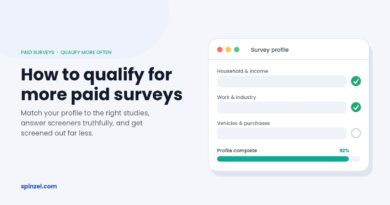
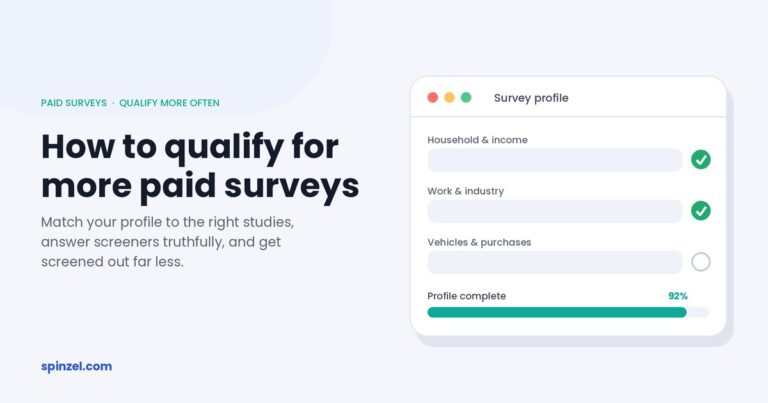
Research panels use your profile details to determine which surveys you qualify for. If you leave sections blank, and the system cannot tell whether you fit a study. So, it skips you.
Therefore, you have to fill in every part the site offers, past the short signup form, across the categories researchers buy against:
Each section you complete provides your profile another opportunity to match an open study. A full profile is the single biggest thing you can do to qualify for more paid surveys, and it takes one sitting.
Spinzel runs the same way: one profile, then surveys matched to it. Create a free account, complete your profile, and get access to more paid surveys.
You change jobs, move cities, buy a car, and each change moves which studies you fit. Keeping it profile updated is a steady part of how to qualify for more surveys. So update details as life changes and revisit the profiling sections now and then.
Many panels also run short top-up surveys that refresh your profile and pay a little, and those widen what you qualify for.
Depending on your truthful and consistent answers, screeners decides that you are the right person for the study. And, this is the central part to how to qualify for paid surveys.
Panels compare what you say now against your profile and your earlier answers.
If you try to play trick with them, it rarely works. The target answer is usually not obvious, by design, and a lucky guess falls apart a few screens later when a related question contradicts it.
Claim a car you do not own or a job you do not hold, and the follow-ups will not line up. The panel reads that as low quality and sends fewer invitations.
Being consistent matters as much as being truthful. Say you are 29 in March and 35 in April, and the system flags it.
Plenty of screen-outs are really misreads. A screener might ask which items you bought in the last three months, and a quick skim has you ticking the wrong boxes. Slow down on the first few questions; those usually decide whether you get in.
Speed costs you a second way. Panels log how long you take, and racing through far faster than anyone could read looks like random clicking. A tripped check voids the response, correct answers and all.
Attention checks do the same. A long grid may hide a line like select disagree here, and missing it can void the whole response.
Not every open survey is worth your time. Sites usually show the length, the reward, and sometimes the topic before you start.
Pick the surveys that relates to your life, like a grocery study if you do the household shopping. This will help you spend less time on screeners you would never succeed. Between two similar surveys, the one closer to what you know passes you more often.
Good surveys do not wait around. The well-paid, well-matched ones fill their quotas within hours, sometimes less.
Checking daily is part of how to qualify for online surveys without missing them, and email or app alerts do the watching for you. Studies launch at all hours, so logging in at different times catches fieldwork that went live while you were away.
Panels check that each member is one real person in the study’s target country. A VPN or proxy can land you in the wrong location, which breaks that check and costs you qualifications. Keep it up and the account can be suspended.
Opening extra accounts to get more surveys ends the same way, with accounts closed and rewards forfeited. One real account, used normally, qualifies more often than any workaround.
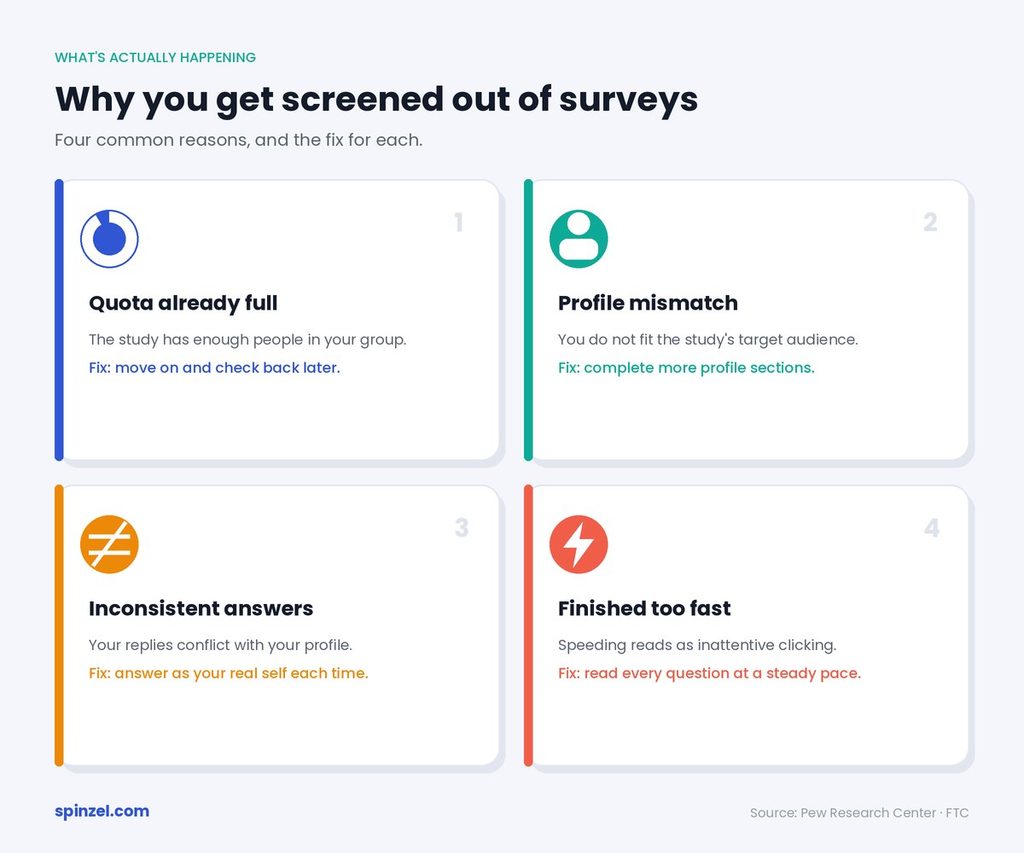
Screen-outs are part of the system, not a mark against you. Usually, the quota for your group is filled up, or the study needs a different profile. What you do next matters:
| Screen-out reason | What is happening | What helps |
| Quota already full | The study has enough people in your group | Move on and check back later |
| Profile mismatch | You do not fit the target audience | Complete more profile sections |
| Inconsistent answers | Responses conflict with your profile | Answer as your real self each time |
| Finished too fast | Speed reads as inattentive clicking | Read every question at a steady pace |
Some panels pay a small amount for a screen-out, or send you to the next study you match. Either way, close it and move on instead of re-answering to slip in.
These habits drag your qualification rate down:
Clear two or three of these and the invitations usually pick up within a few weeks.
Keep your expectations realistic. Per-survey rewards are small and vary with length, your profile, and how much fieldwork is live; the how much paid surveys actually pay page has the ranges.
One line worth remembering before you join anywhere: a real survey never charges you to sign up or to cash out a reward. The FTC’s advice on spotting a scam and AARP’s guidance on survey scams both say the same, and a site that asks for payment is one you can report to the FTC.
If you want to know how to always qualify for surveys, you may not. And, anyone promising otherwise is selling something: open quotas and target audiences are not yours to control.
The match is yours to control. Keep the profile full and current, answer screeners truthfully, and check in daily for new studies. Do that, and you qualify more often, with fewer screen-outs to sit through.
When you are ready, browse the available surveys on Spinzel, finish your profile, and start with the studies that fit you.
Usually the quota for your group is full, or your profile does not match what the study wants. Fill in more of your profile and start surveys that fit your life, and it happens less.
No. Every study wants a certain audience and has limited spots, so screen-outs are unavoidable. A complete profile and consistent answers raise your qualification rate, but nothing qualifies you for all of them.
Answer truthfully. The target answer is usually hidden on purpose, and false answers tend to contradict later questions, which flags your response and cuts your future invitations.
It depends on your profile, your location, and how much fieldwork is live. A fuller profile and daily checking usually mean more matches, though the number differs for everyone and no site can promise a fixed amount.
No. A VPN or proxy puts you in the wrong location and breaks the identity check, which costs you qualifications and can get your account suspended. Stick to one real account with no location tools.