

Nobody talks about voice work the way they should. It doesn’t trend on Twitter, it doesn’t have a subreddit with 2 million followers, and it’s rarely the first thing a career coach recommends. But people are pulling $3,000, $5,000, even $8,000 a month recording audio in spare bedrooms — and most of them started with an $80 microphone and zero industry contacts. Voice over work from home has that kind of trajectory when you commit to it.
This guide covers the full picture, like how to start voice acting with no background, what gear actually matters versus what’s a waste of money, where paying jobs live, and how to price yourself without giving work away.
Key Takeaways
- One decent mic gets you started immediately.
- Your demo reel wins or loses every job.
- No degree or certification required at all.
- Niche focus earns 2–3x more than generalist work.
- Voices.com and Upwork have active postings daily.
- Cold reading fluency is the fastest-paying skill to develop.
- Consistent follow-up with past clients fills your calendar.
What is Voice Acting & Voice-Over Work?
These two terms get lumped together constantly. The work is different enough that knowing the distinction shapes the direction you take.
Voice acting is the performance of characters in video games, animation, audiobooks, and apps. You’re not just delivering lines; you’re making someone believe a character is real.
Voice-over work is more functional, narrating a training course, voicing a product ad, recording IVR prompts for a bank’s phone system, or narrating a documentary. Less theatrical range, more precision and consistency.
Both categories feed voice over jobs online every single day.
Why Voice Acting is a Great Online Income Source
A Blue Yeti microphone runs about $130. Free recording software handles the basics. A quiet room, no professional treatment required. That’s genuinely the full starter kit. Compare that startup cost to almost any other freelance skill that earns at this level, and the entry barrier is remarkably low.
The ceiling, though? Not low. Experienced narrators working in e-learning or audiobooks regularly bill $200–$500 per finished hour of audio. A single e-learning project covering eight hours of content can pay $4,000. That’s from one client, on one project.
Voice over work from home means the client never sees where you’re recording. The audio file lands in their inbox and either sounds right, or it doesn’t. A narrator in Bangalore competes on the same terms as one in Boston. For voice over freelance jobs specifically, the global market is open from day one.
Synthetic voices are improving. But briefs that pay well at the premium end still want warmth and personality that text-to-speech tools consistently miss. On top of that, AI voice model training is now its own paid category; companies building voice products need thousands of hours of clean human recordings across accents, ages, and languages. Real work. Real pay. Growing fast.
Income from voice work builds over months, not days. While your profile gains traction, Spinzel’s Best Paid Surveys is a straightforward way to earn something in the meantime.
Skills Needed to Get Started
No drama school required. But clients evaluating voice actors are listening for specific things, and knowing what they are from the start stops you wasting time on the wrong kind of practice.
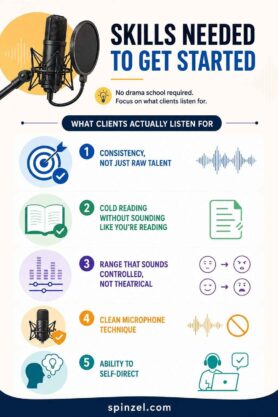
What clients actually listen for
- Consistency, not just raw talent. A director or content producer doesn’t want to coach you through 15 attempts to get one usable take. Delivering clean, workable audio by take two or three is what gets you rehired. Vocal talent without consistency is a liability in production environments.
- Cold reading without sounding like you’re reading. Most voice over jobs online involve scripts handed to you minutes before recording. Scanning a page and delivering it as natural speech — not recitation — is a rare skill and a high-value one. This is the single thing worth practising most aggressively when figuring out how to become a voice actor.
- Range that sounds controlled, not theatrical. An e-learning narrator and a children’s audiobook narrator need completely different registers. The goal isn’t impressions or exaggerated characters, it’s controlled, subtle variation. Warm versus authoritative. Calm versus urgent. That range, when it sounds natural, is what makes clients come back.
- Clean microphone technique. Plosive pops, mouth noise, and audible breath catches reject recordings before anyone even evaluates the performance. Technical basics. Learn them before you build anything else.
- Ability to self-direct. Remote clients aren’t sitting in a virtual session with you. You get a brief, you interpret it, you deliver files. Making confident, creative decisions without constant reassurance is what professional clients specifically pay for.
Equipment & Setup for Beginners
People massively overcomplicate this. The minimum viable setup for voice over work from home is genuinely minimal.
What you actually need on day one
Microphone. A USB condenser mic removes the need for an audio interface and still produces recordings that clients accept without complaint. The Blue Yeti ($130) and Audio-Technica AT2020 USB ($99) are the two most reliable beginner choices. Don’t spend more until you’re earning regularly.
Headphones. Closed-back monitoring headphones. The Sony MDR-7506 is an industry standard precisely because it’s honest; you hear exactly what you’re recording, not a flattering version of it. That honesty matters during editing.
Recording software. Audacity is free and handles everything a beginner needs. Reaper costs $60 and is meaningfully better. Adobe Audition is excellent but subscription-priced; save it for when billing justifies it.
Room treatment. A booth is not required. A wardrobe packed with hanging clothes is genuinely one of the most effective acoustic absorbers available. Recording under a heavy duvet works. A carpeted corner between two bookshelved walls works. Fix the room before upgrading the mic because room acoustics affect recordings more than microphone quality at this level.
When to upgrade
Once you are confident and have consistently booked and billed around $1,000 a month, go with the XLR condenser mic with a Focusrite Scarlett Solo interface. The quality jump is massive. Before that point, the USB setup isn’t holding you back.
Best Platforms to Find Voice-Over Jobs
More places exist to find voice over jobs online than most beginners realise. Which platform suits you depends on where you are in the process.
Upwork: Thousands of live listings at any given moment. Corporate narration, multilingual recording projects, explainer videos, AI training datasets. Competitive but high volume. Set a fair rate and respond to briefs the same day they post.
Voices.com: Purpose-built for voice talent. Clients here tend toward production agencies, brand teams, and established media companies. Average project budgets sit higher than those on general freelance platforms.
Voice123: Subscription-based platform that sends you audition opportunities matching your profile. Better suited to someone who already has a polished demo than a complete beginner still recording first samples.
ACX: Amazon’s audiobook platform. Connects narrators with authors and publishers. Royalty-share deals mean no upfront payment, but a successful title pays out for years. Per-finished-hour rates are available too.
Fiverr: Lower prices, higher volume. Builds your first reviews and gets real client feedback on your delivery. Don’t build your whole business here, but don’t skip it in the early months.
Backstage: Broader creative platform covering voice and acting work. Worth a profile if character work is part of your focus.
Start on two platforms max. Build reviews. Then expand outward.
More income sources give you breathing room while your voice work builds. Spinzel’s Paid Surveys lists verified options that genuinely pay — curated, not padded.
How to Build a Voice Portfolio
A profile without demos gets ignored immediately. Every serious client wants to hear from you before they reply to your pitch, which makes a demo reel not optional but foundational. This is the core of how to start voice acting professionally.
What a working reel actually needs
Commercial reel (60–90 seconds). Cover at least three distinct styles — energetic and punchy, warm and personal, direct and authoritative. The goal is to show that your voice adapts, not that you’re versatile in a generic sense.
Narration/corporate reel. This includes e-learning, training, and explainer work — the bread and butter of voice over jobs online for most working narrators. Clean, measured, zero over-performance. Clients hiring for this work are allergic to anything theatrical.
Character reel (only if pursuing that direction). Brief clips. Genuinely different voices. Not impressions of existing characters — original creations. If two characters on the reel sound like variations of the same voice, cut one of them.
Audiobook sample. 60–90 seconds demonstrating that you can carry a listener through long-form content without losing consistency or bleeding energy.
Every demo: lead with your best 10 seconds. Decision-makers decide fast. If your strongest moment is buried at 45 seconds, they’re already gone.
Post demos on SoundCloud, your own website, and inside every platform profile.
Pricing Your Voice Services
Undercharging is the single most common mistake people make when learning how to make money doing voice-overs. It’s also the one that creates the worst client relationships.
What the market pays at various levels
- Short commercial under 60 seconds: $100–$250
- Corporate explainer video, 2–3 minutes: $150–$400
- E-learning module, per finished hour of audio: $200–$500
- Audiobook narration, per finished hour: $150–$400 (royalty-share also available via ACX)
- IVR/phone system recordings: $200–$600, depending on script volume
Clients at the bottom end of those ranges tend to generate the most friction — the most revision requests, the vaguest feedback, the slowest approvals. Clients who pay properly tend to know what they want, communicate it clearly, and come back with more work.
Charge enough that the project is worth your time, even if it runs 20% over scope. The freelancers with strong repeat business aren’t the cheapest — they’re the most reliable at delivering usable audio without drama.
Tips to Get More Clients
What actually works
Your bio is a pitch, not a resume. “Professional voice actor with four years of experience in narration work” tells a client nothing. “I record warm, clear narration for e-learning teams who need audio that sounds like a knowledgeable colleague rather than a scripted read”, tells them exactly who to hire.
Speed separates you from most of the competition. Clients post jobs and hear back over the next day or two. Reply within two hours with a focused, specific proposal — not a template. That alone puts you ahead of 80% of applicants.
Reviews compound. Five detailed, genuine reviews on your profile are worth more than a month of cold outreach. After every project that goes well, ask for one. Most satisfied clients will write something if you make it easy and ask while the work is still fresh.
Build spec samples for the work you actually want. If you want fintech narration clients, record a piece that sounds like actual fintech training content — not a generic demo. Clients hire what they can already hear. Don’t make them imagine it.
LinkedIn is underworked in this space. Short audio clips posted as native content, direct connection requests to content leads and L&D managers, substantive comments on production company posts — this route bypasses competitive platform bidding and regularly leads to longer-term working relationships.
Specialise. Medical narration. Software explainers. Luxury brand work. The voice actor with a defined niche commands a premium because they’re not a generalist option — they’re the specific, right answer to a specific problem.
While you’re building your client base, Spinzel’s Best Money Earning Apps covers the top legitimate apps for earning on your phone. All vetted, no fluff.
Conclusion
Most people who look into voice acting browse for a week, don’t record anything, and talk themselves out of it. The ones making consistent money from it aren’t more talented — they’re the ones who recorded something imperfect, put it somewhere people could find it, and kept going from there.
The work exists right now. Today. Thousands of live voice-over briefs on Upwork alone. E-learning companies are perpetually hiring narrators. AI companies are paying for hours of clean human audio. Audiobook publishers are constantly needing new voices. None of this is a future projection; it’s the current state of the market.
Get one decent mic. Record something. Post it. The rest — the rates, the niche, the platforms, the client relationship- get sorted by doing rather than planning.
What’s actually in the way for you right now — gear, confidence, time, or something else? Drop it in the comments.
FAQs
1. How do I start voice acting with no prior experience?
Record a rough demo at home, create profiles on Upwork and Fiverr, and apply for beginner-level projects. Your first five paid gigs teach more than any preparation does.
2. How much can someone realistically earn from voice over jobs online in year one? Entry-level work pays $50–$200 per project. Consistent effort in a defined niche gets many narrators to $1,500–$3,000 monthly within 8–12 months.
3. Is expensive equipment necessary before starting voice over work from home? No. A $100 USB mic and a quiet, soft-furnished room produce perfectly acceptable audio for most entry and mid-level voice over freelance jobs.
4. Does AI voice technology make this a bad time to start?
The opposite. AI voice model training is now a paid work category itself — companies need thousands of hours of clean human recordings, actively creating new voice over jobs online.
5. Which platform suits a complete beginner best for voice over freelance jobs?
Upwork for volume and variety. Fiverr for early reviews. Once you have a strong demo, add Voices.com or Voice123 for higher-budget clients.