The Side Income Nobody Told You About — Until Now
Students, homemakers, freelancers between gigs, and regular people are running print-on-demand stores with actual recurring revenue and zero warehouse drama. But I’ll be upfront: it takes real effort early. This guide gives you a grounded view of how it works and the moves that separate the stores earning $50/month from the ones clearing $3,000.
Key Takeaways
- No inventory needed — items only print when ordered.
- Pick a tight niche before you open any design tool.
- Platform choice affects profit margins more than most realize.
- Great mockup photos drive more clicks than paid ads.
- Validate demand first — never design blindly.
- Seasonal designs reliably spike revenue every year.
- Marketing consistency builds compounding organic traffic.
What Is Print-on-Demand?
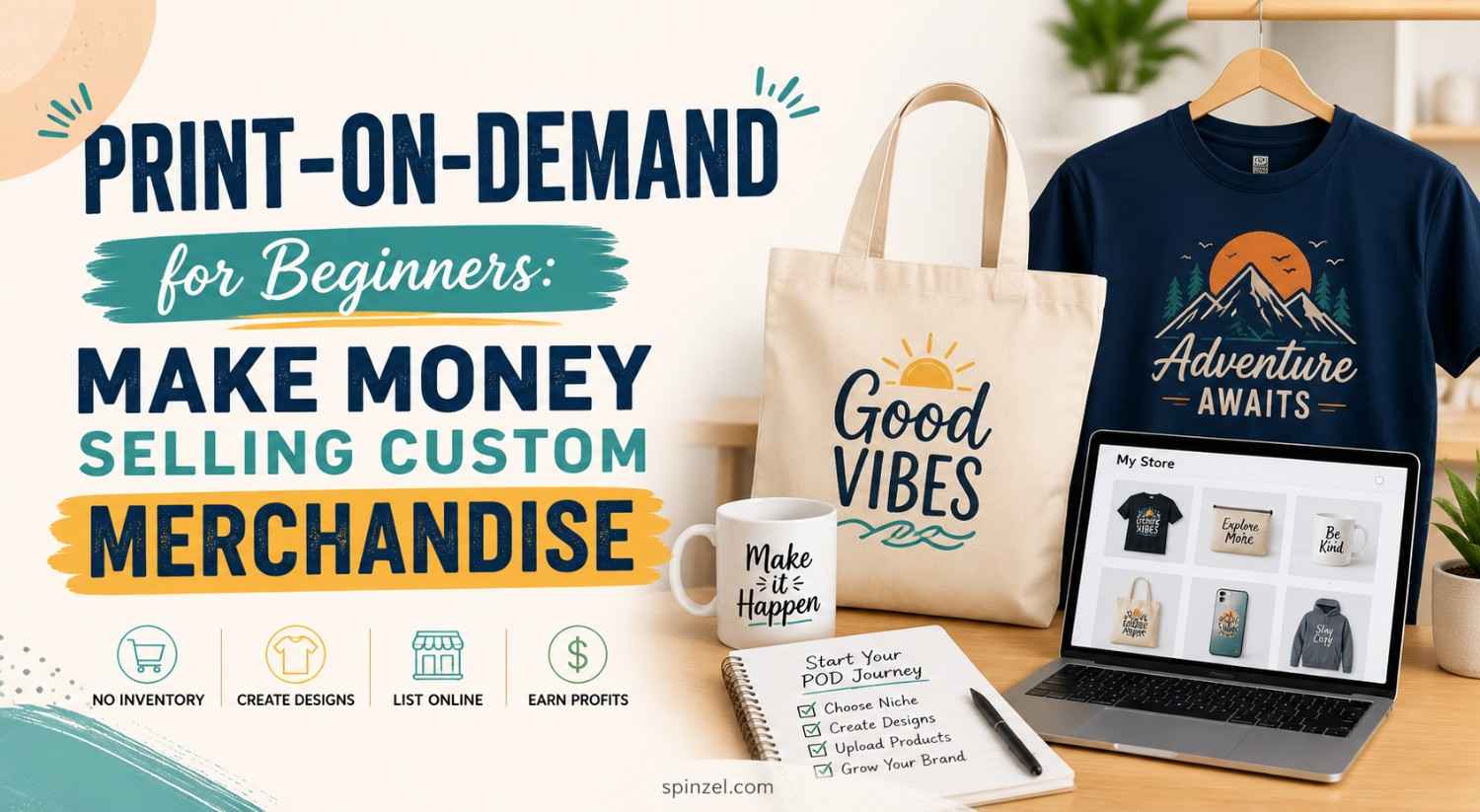
A customer buys a t-shirt from your store. The order routes to a printing company, which prints your design, packages it under your brand name, and ships it straight to your buyer. You never touch the product. You pocket the difference between what the customer paid and what the printer charged.
That’s the whole model — and it extends well beyond shirts. Mugs, hoodies, phone cases, tote bags, canvas prints, notebooks — whatever carries a design, someone is selling it through print-on-demand merchandise and making real money from it.
What separates this from generic drop-shipping is the customization layer. Your designs. Your brand. Items people genuinely can’t find elsewhere. That distinction is what commands real prices.
How Print-on-Demand Works
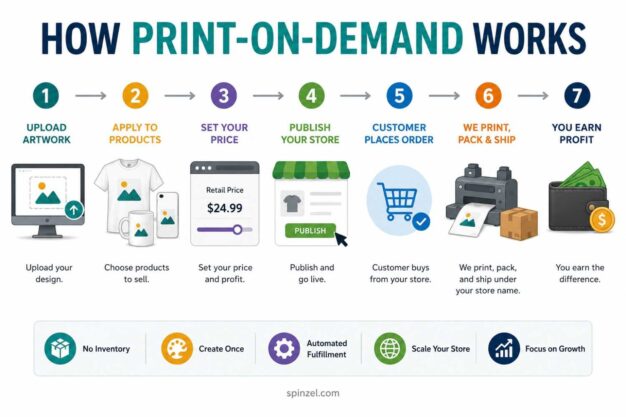
You upload original artwork to a POD platform, apply it to products, set your retail price, and publish. When a buyer purchases, the order automatically routes to the print provider — no manual forwarding needed. They print, pack, and ship under your store name. You collect the sale price minus their base cost. Clean, repeatable, and entirely hands-off on fulfillment.
Why It’s a Great Business Model for Beginners
Zero financial exposure upfront. Products only cost money after a customer has already paid you for one. That’s a structurally safer starting position than nearly any other business.
Location doesn’t matter. Run it from Bengaluru, Berlin, or your kitchen table. Doesn’t change a thing.
Scales without proportional effort. Adding thirty new designs doesn’t require hiring staff or renting storage. You upload and list.
The ceiling is higher than most beginners expect. Some POD sellers clear six figures annually. Most don’t reach that — but $500–$2,000/month in semi-passive income from print-on-demand services genuinely changes the picture for someone juggling other responsibilities. You can easily run this alongside paid online surveys or other side income while traction builds.
Best Print-on-Demand Platforms
Printify
Printify connects your store to a global network of print providers, keeping pricing competitive. More than 1,300 products, free to start, integrate with Shopify, Etsy, WooCommerce, and TikTok. Always order samples first, quality can vary slightly by provider.
Printful
Printful runs its own production facilities, meaning tighter consistency. Higher base costs than Printify, but the branding options and product quality make it the right pick for building a serious brand.
Redbubble
Redbubble has a built-in buyer marketplace — no separate storefront required. Upload designs, list, done. Less control, but the easiest possible starting point.
Merch by Amazon
Merch by Amazon puts your designs in front of Amazon’s traffic. Invite-only and slow to approve, but worth applying to once you have proven designs. Royalties per sale, zero fees.
Gelato
Gelato fulfills locally across 32+ countries, which means faster delivery for international buyers — a real edge if you’re targeting markets outside North America.
Building a POD store takes a few months to gain traction. Spinzel’s Best Paid Surveys list covers the highest-paying legit survey platforms — a clean way to keep cash flowing while your store finds its feet.
How to Create and Sell Custom Merchandise
Start with Canva or Kittl — both produce clean, print-ready designs without any formal training. Before opening either, spend twenty minutes on Etsy browsing bestsellers in your target niche. Study the typography styles, humor register, and color choices that are already selling. Then create something original in that same emotional lane.
For your storefront: Etsy is the fastest path to organic traffic for beginners. Shopify offers more control but demands that you generate your own visitors, a harder starting position. Many sellers prove their designs on Etsy first, then build a Shopify store once they know what converts.
On pricing, don’t race to the bottom. A well-executed niche design on a hoodie can sit at $55–$65 without scaring off the right buyer. Competing on price with established sellers who have 2,000 reviews is a losing game.
Choosing Profitable Niches for Print-on-Demand
This is the highest-leverage decision you’ll make. The mental model: passion + identity + spending history. You want a community that’s emotionally invested, where the product signals group membership, and where people demonstrably already spend money on related things.
What consistently works in print-on-demand merchandise: occupational identity (nurses, teachers, electricians), pet breed owners, regional/cultural pride, and hobby subcultures like trail runners, board gamers, or sourdough bakers. The more specific, the less competition.
Validate before you design. Run your niche keywords through Erank or Merch Informer and check real search volume against competition. A niche with 10,000 monthly searches and 200 competing listings beats a niche with 100,000 searches and 50,000 sellers every time.
Marketing Your POD Store
Etsy SEO first. Every character of your title, every tag, every line of your description is searchable. Think like a buyer — not “funny nurse shirt” but “funny RN gift for nurse week.” Use all 13 available tags. Update listings seasonally.
Pinterest is criminally underused. It functions as a visual search engine where pins surface in results for months after posting. Static Instagram posts die in 48 hours. A well-optimized Pinterest pin keeps delivering clicks long after you’ve forgotten you made it.
Short-form video works. TikTok or Reels showing your design process, mockup reveals, or order notification screenshots builds authentic interest without a production budget.
While organic traffic builds, Spinzel’s Paid Surveys keeps supplemental income coming in — no skills required beyond your honest opinions.
Tips to Maximize Profits
Bundle complementary products within the same niche: a coffee lover designs works on mugs, tote bags, and coasters. Getting a buyer to add a second item costs you almost nothing.
Build a seasonal design calendar six to eight weeks ahead of major moments — Valentine’s, teacher appreciation, graduation season, Halloween. Sellers who plan ahead consistently outperform sellers who react late.
Study your analytics. Low click-through? Fix the mockup photo. Clicks but no purchases? Fix the price or description. The data tells you exactly what needs attention — most sellers never actually look.
Check Amazon FBA if you eventually want to scale proven designs into physical inventory — it pairs logically with an established POD catalog.
Common Mistakes to Avoid
Designing for yourself. What you personally love and what a specific buying community responds to are usually different things. Market data beats personal taste every time.
Skipping sample orders. A print defect that reaches customers at scale will crater your review score. Order samples on every new product before listing at volume.
Spreading across too many unrelated niches. Fifteen strong listings inside one focused niche outperform fifty mediocre listings across five unrelated ones. Depth builds Etsy algorithm authority.
Quitting at week six. Most stores that eventually earn real money didn’t see meaningful revenue until month three or four. The sellers who quit early almost always do so just before traction would have arrived.
Conclusion
Print-on-demand rewards patient-specific, consistent builders. The upfront cost is almost entirely time spent researching, designing, and iterating. The payoff compounds: a strong listing that earns $80 this month keeps earning next month with no additional work.
The biggest opportunity right now is in micro-niches that bigger sellers ignore. Go narrower than feels comfortable. Design for a specific person, not a general category. Market consistently for ninety days before drawing conclusions.
Start today: Sign up free on Printify or Printful, run your niche idea through Etsy’s search bar before closing this tab, and bookmark Spinzel’s best paid surveys as your income bridge while the store builds.
What niche are you considering for your first print-on-demand store? Drop it below — let’s pressure-test whether it has real commercial legs.
FAQs
1. Is print-on-demand really free to start?
Yes. Printify and Printful both have free plans. You only pay production costs after a customer has already purchased.
2. How much can a beginner realistically earn?
With consistent effort, most beginners see $200–$1,000/month within their first six months of active selling.
3. Do I need design skills to sell custom merchandise online?
No. Canva and Kittl are built for non-designers. Typography-based text designs sell well and require zero illustration skills.
4. Which platform is best for a complete beginner?
Etsy as your storefront, paired with Printify for fulfillment — the most forgiving combination for someone just starting out.
5. Is the print-on-demand space too crowded?
Generic categories are saturated. Specific micro-niches — occupational humor, regional identity, hobby subcultures — still have plenty of open space.