

Okay, real talk, “make money while you sleep” is probably the most overused phrase in the personal finance space. You’ve seen it on Instagram reels, heard it in podcasts, and read it in every second LinkedIn post. And most of the time? It’s paired with a photo of someone on a laptop near a beach. Very motivational. Mostly useless.
But here’s the thing. Strip away the lifestyle marketing and the hype — the concept itself is completely real. People do earn money without clocking in every day. Not through luck. Not through some secret course that costs ₹49,999. Through systems. Boring, unglamorous, actually takes work systems.
Nobody warned me how much setup passive income needs before it becomes, well, passive. That’s the gap this guide tries to fill. No fluff, no fantasy — just what actually works when you’re trying to earn money while you sleep.
Key Takeaways
- Passive income requires upfront effort, not zero effort.
- Digital products generate income around the clock automatically.
- Affiliate marketing works best with a loyal, engaged audience.
- Automation tools are essential for scaling passive income online.
- Diversifying income streams reduces financial risk significantly.
- Paid surveys are a low-barrier passive income starter option.
- Consistency in building beats sporadic bursts of activity.
What Is Passive Income?
Here’s a definition that actually makes sense in the real world: passive income is money that keeps coming in after you’ve done the core work. Not money that falls from the sky. Not residual income from doing nothing. Money from something you built — a product, a piece of content, an investment — that runs without you showing up every single day.
Technically, the IRS describes it as income from rental activity or a business you don’t materially participate in. Fine. But in practical terms — for the freelancer, the homemaker, the side-hustler — passive income is far simpler than legal definitions suggest.
It’s the eBook someone bought at midnight while you were watching a show. The affiliate link that earned you ₹800 from a blog post you published four months back. The course that sold three copies on a Tuesday, you didn’t even touch your laptop.
How Is Passive Income Different from Active Income?
With active income, the math is cruel and simple. One hour of work equals one hour of pay. Stop working, stop earning. The ceiling is directly tied to your time, which is, unfortunately, finite.
Passive income flips that equation. You front-load the effort. You spend time building the thing. And then the thing — ideally — keeps producing. The ratio of reward to ongoing effort gets better the longer the system runs. That’s the actual appeal. Not laziness. Leverage.
Why Passive Income Matters for Business Sustainability
Most businesses, especially smaller ones, operate on a single revenue thread. One client base, one service line, one platform. And when that thread snaps — a client walks, an algorithm changes, a market contracts — the whole thing unravels fast.
Passive income online isn’t just a freelancer’s hobby project. It’s a legitimate layer of financial protection. Licensing revenue, digital product sales, affiliate income, content monetization — these aren’t vanity metrics. They’re real buffers that active income alone doesn’t build.
How Passive Income Works
Most people understand the concept but get stuck on the mechanics. How does money actually move without daily effort? Where does it come from, and how do you set it up?
The core loop isn’t complicated: you put in time or money upfront, you build something with lasting value, and that something earns for you over time. The “something” varies wildly — it could be a YouTube video, a software plugin, a stock portfolio, or a downloadable template.
The Three Pillars of Passive Income
1. Build or Buy an Asset: A blog, a course, a rental property, an index fund, a digital product — these are all assets. The asset is the engine. Without it, nothing runs.
2. Set Up a Monetization Mechanism: Ads, affiliate links, product sales, subscriptions, dividends — these are how the asset generates cash. An asset without monetization is just a hobby.
3. Automate the Delivery Payment processors, email sequences, and digital download platforms — these handle what would otherwise need a human. When automation works well, the sale-to-delivery cycle runs completely on its own.
None of this requires a complex setup. Some of the most effective online passive income ideas run on a simple landing page, a basic email list, and one good product. That’s genuinely it.
Best Passive Income Ideas
The internet has no shortage of passive income ideas lists. Most of them are vague and repeat the same five things without telling you what the actual challenges are. Below are options that work — with honest trade-offs included, because pretending every option is easy for everyone serves nobody.
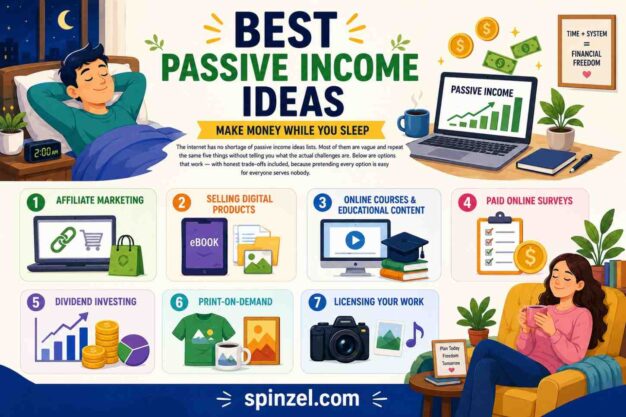
Affiliate Marketing
The model is simple: recommend a product, share a link, earn a cut when someone buys. What makes it hard is that it only works if people trust you enough to click your recommendations.
Amazon Associates, ShareASale, and Impact are the platforms most people start with. Thousands of products across every niche imaginable.
But here’s the part most guides skip: if you don’t have an audience, you don’t have affiliate income. A blog with three visitors a month earns nothing from affiliate links. Build the audience first, place the links second. In that order.
Selling Digital Products
Templates, eBooks, presets, Canva designs, Notion dashboards, stock photos — the common thread is zero inventory and infinite copies. You make the thing once. You sell it as many times as the market allows.
Gumroad and Payhip are the most beginner-friendly platforms to start. Etsy works well if you’re selling printables or design assets with visual appeal.
The part people underestimate is discoverability. A great product sitting on a platform nobody visits earns nothing. Marketing is not optional — it’s the second job.
Online Courses and Educational Content
If you’re good at something — really good — there is a market for learning it from you. Not just formal skills like coding or accounting. Baking. Furniture restoration. Language learning. Portrait photography. The niche doesn’t have to be massive.
Teachable, Udemy, and Thinkific host the infrastructure. You focus on recording and structuring the content. They handle payments, hosting, and delivery.
Creating a course takes a real investment of time upfront — don’t let anyone tell you otherwise. But a solid course can sell for years with minor updates. The long-term return makes the initial grind worth it.
Paid Online Surveys
Not the flashiest passive income idea, and definitely not a full-time replacement for anything. But for people who want to make money while you sleep with literally zero setup, zero investment, and zero technical skill? Surveys are the most accessible starting point on this list.
Spinzel connects everyday users with brands willing to pay for genuine opinions. You fill out surveys during downtime. You get compensated. That’s the entire model.
Zero setup, zero investment. Start earning with Spinzel’s paid surveys here — straightforward, legitimate, and one of the fastest ways to begin.
Dividend Investing
Buy into companies or ETFs that distribute profits to shareholders regularly. Sit on the investment. Receive payouts. This isn’t exciting, but it’s one of the most time-tested ways to generate passive income online without managing a product or content calendar.
Zerodha works well for Indian investors. Robinhood is accessible for US-based investors. The catch — and it’s a real one — is that the income only becomes meaningful at scale. A ₹10,000 portfolio pays out pocket change. The strategy rewards patience and compounding more than it rewards early enthusiasm.
Print-on-Demand
You design something — a quote on a shirt, an illustration on a mug, a poster for a niche community. Upload it to a platform. When a buyer places an order, the platform handles printing, packaging, and shipping. You collect a margin on every sale.
Redbubble, Merch by Amazon, and Printful are the main platforms worth knowing. The work is front-loaded in design creation. After that, your role is mostly traffic generation.
Licensing Your Work
Photographers, musicians, writers, developers — anyone who creates intellectual property can earn royalties on it. Every download, stream, or usage generates a payment without additional work from you.
Shutterstock, Getty Images, and AudioJungle are where most creators start when licensing their work for passive income.
Got spare time between tasks? Take paid online surveys on Spinzel and earn from your opinions — no experience, no barrier, no catch.
Tools to Automate Earnings
You can build a passive income stream without automation, but you’ll end up managing it manually forever. That’s not passive — that’s just a different job. The tools below are what separate income that truly runs on its own from income that constantly demands your attention.
Email Marketing Automation
A customer finds your product, signs up, gets a welcome sequence, sees an offer, and buys all without a single manual step. That’s what email automation does.
Mailchimp, ConvertKit, and ActiveCampaign all offer sequence builders capable of handling this end-to-end. For most online passive income ideas, email is the monetization layer that makes everything else function properly.
Payment and Delivery Automation
Stripe, Razorpay (India), and PayPal process the payment.SendOwl or Gumroad delivers the product. The customer buys, receives, and walks away satisfied — and you weren’t involved in any part of that transaction.
Content Scheduling Tools
Consistent content is what brings people to your passive income assets in the first place. Buffer, Hootsuite, and Later let you schedule content weeks ahead, which means your presence stays active even when you’re not.
Analytics and Optimization
Google Analytics and SEMrush show you what’s actually driving traffic and converting. Without this data, you’re guessing. With it, you know exactly where to put your energy.
Tips to Build Long-Term Passive Income
Building something that genuinely earns money while you sleep takes longer than most people expect and requires more consistency than most people sustain. The tips below aren’t hacks — they’re just what actually works when you look at people who’ve built real, durable passive income streams.
Start With One Stream, Then Diversify
Pick one thing. Work it until it actually earns something. Then add another stream. The people who try to build five passive income ideas at once almost always end up with five half-built things and zero income.
Dilution kills momentum, especially early.
Prioritize Assets That Compound
A blog post that ranks on Google in month three is still bringing in traffic in year three. A digital product with strong reviews sells partly on social proof that builds over time. When you’re choosing what to build, ask: Will this be worth more in two years than it is today?
Treat It Like a Business from Day One
The “I’ll get to it when I have time” approach produces nothing. Schedule it. Set income targets, even if they’re small. Track the numbers. The discipline of running it like a real business — not a side project — is what separates people who actually build passive income from people who just plan to.
Reinvest Early Earnings
The temptation to pocket the first ₹5,000 or $100 is real. Fight it. Reinvest early returns into better tools, paid traffic, or outsourcing tasks that eat your time. The compounding effect accelerates significantly when you feed the system instead of draining it.
Stay Updated on Platform Changes
Platforms change. Affiliate programs close. Algorithms get updated. Payment policies shift. Passive income online is never fully “set and forget” — it requires occasional attention to stay current. Never let one platform control your entire income, either.
Combine Active and Passive Income Strategically
The people who build passive income fastest usually fund it with active income first. A consultant turns their process into a course. A designer packages their templates. Active work reveals what people want to pay for — and passive income captures that demand at scale.
For a broader breakdown of earning online in 2026, Spinzel’s ultimate guide to making money online is worth reading through.
Conclusion
Learning how to make money while you sleep isn’t a shortcut discovery. It’s a slow build. A patient, deliberate investment of time and effort into things that keep paying you back after the work is done.
Everything covered here — affiliate marketing, digital products, dividend investing, paid surveys, licensing — works. The gap between people who earn passively and people who just talk about it is almost always execution, not information.
Start somewhere small. Keep building. Even ₹2,000 a month in passive income changes how you relate to money — and that effect compounds in ways that are hard to predict from the beginning.
If you want the most frictionless entry point with no upfront cost? Spinzel’s paid survey platform is a practical first step.
Your money shouldn’t clock out when you do.
FAQs
1. Is it really possible to make money while you sleep?
Yes. Through digital products, affiliate marketing, dividends, and automated systems, income can be generated without active daily effort.
2. How much money do I need to start building passive income?
Many options like blogging, surveys, and digital products require little to no upfront investment to begin.
3. How long does it take to earn passive income online?
Depending on the method, expect 3–12 months before seeing consistent, meaningful returns from most passive income streams.
4. Are paid surveys a legitimate passive income source?
Yes. Platforms like Spinzel pay real money for opinions. It’s a modest income, but completely legitimate and beginner-friendly.
5. What is the best passive income idea for beginners?
Paid surveys, print-on-demand, and affiliate marketing are the lowest-barrier entry points for most beginners starting out.