Rent-free. Staff-free. Logistics handled by someone else entirely. The Amazon FBA model strips away the parts of running a product business that usually eat all the money and time before anything actually scales. What you’re left with is a leaner operation than most physical retailers will ever have, and access to a customer base they’d […]
Rent-free. Staff-free. Logistics handled by someone else entirely. The Amazon FBA model strips away the parts of running a product business that usually eat all the money and time before anything actually scales. What you’re left with is a leaner operation than most physical retailers will ever have, and access to a customer base they’d spend years trying to build.
Amazon pulls in over 2.5 billion visits every month. These aren’t window shoppers. They arrive with credit cards ready and search terms typed. Your job isn’t to build trust from scratch — that part’s already done. Your job is to put the right product in front of them.
Here, we share the Amazon Seller Guide that covers what FBA actually is, what it costs to start, how to find a product worth selling, and what it realistically takes to make money.
Amazon FBA (Fulfillment by Amazon) is a fulfillment program where you send your products to Amazon’s warehouses, and Amazon takes it from there — storage, picking, packing, shipping, tracking, and customer returns. Every bit of it.
The seller’s role becomes: source products, create listings, manage inventory levels, run advertising. That’s it. You’re not boxing up orders at midnight or arguing with couriers about lost packages. Amazon handles the part that usually breaks small businesses at scale.
Check out Amazon’s official FBA program page to see current fee structures and program details before committing.
Fulfilled by Merchant (FBM) means you store and ship everything on your own. At 10 orders a week, that’s manageable. At 100? You’re now a part-time warehouse manager. FBA lets you skip that entire chapter. You pay fees — fulfillment fees, storage fees, referral fees — but in return, your products carry the Prime badge, and Prime members spend more, full stop.
The flow is straightforward once you’ve seen it laid out plainly.
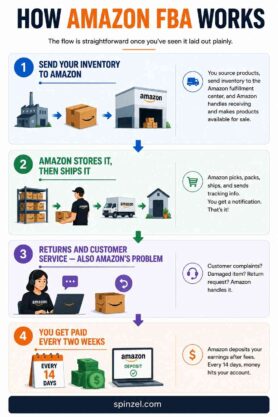
You source products from a manufacturer or wholesaler, send inventory to the Amazon fulfillment center assigned to you, and Amazon handles the receiving process before making the products available for sale. From that point, they own the logistics.
When a customer orders your product, Amazon picks it off the shelf, packs it, ships it, and sends tracking info. You get a notification. That’s your involvement in the transaction.
Buyer complaining about a damaged item? Amazon handles it. Return request? Amazon processes it. This matters more than most new sellers realize until they’ve dealt with a wave of returns manually.
Amazon deposits your earnings after subtracting their fees. Every 14 days, money hits your account. For sellers used to chasing invoices or waiting on clients, this part feels almost suspiciously clean.
Why build an Amazon FBA business instead of just setting up a Shopify store and handling everything yourself?
The existing traffic. Building a standalone e-commerce brand means spending years — and real marketing budget — just getting people to your site. Amazon already has the visitors.
Prime eligibility. FBA products get the Prime badge automatically. Buyers filter by Prime constantly. Without it, your listing loses before the scroll even begins.
Credibility by association. Customers trust Amazon’s fulfillment. A small brand they’ve never heard of ships via Amazon? That trust transfers. Same product on an unknown website? Much harder sell.
Freedom to work from anywhere. If your products are in Amazon’s warehouse and your listings are optimized, your business runs while you sleep. Not every day, not automatically, but the infrastructure supports it.
Building your FBA business takes time upfront. While you’re in research mode, Spinzel’s best paid surveys are worth checking out — legitimate earning opportunities that cost nothing to start.
Go to Amazon Seller Central and register. Two options:
Start with Professional if you’re serious. Amazon’s beginner’s guide walks through the full setup if you want the official walkthrough.
Four approaches worth knowing:
Most sellers who build long-term Amazon FBA businesses land on private label. The brand you build around a product is an asset you own.
Separate business account and separate card. Log what you spend on inventory, what you spend getting it to Amazon, what goes into ads, and what the tools cost. Sellers who skip this step often discover they weren’t profitable six months in. By then, the hole is deeper.
The criteria that consistently produce working results:
Most private label sellers go to Alibaba to find manufacturers, primarily in China. The process: search your product category, contact 5–8 suppliers, always order samples before committing, negotiate price and minimum order quantity, then use a freight forwarder to ship directly to Amazon.
Your first order should be conservative — 200 to 300 units is enough to validate real-world demand without betting the farm on a guess.
Waiting on your first shipment? That window is good for more than watching tracking updates. Spinzel’s paid online surveys fill that time with actual income.
A live listing that nobody sees is a wasted investment. Getting found on Amazon takes deliberate effort.
Your listing is your sales page. Treat it that way.
Amazon Sponsored Products ads are how new listings build momentum. Budget $5–$15/day at launch. Give campaigns 3–4 weeks to accumulate data before making major changes. Early on, the point isn’t a perfect return on ad spend — it’s figuring out which search terms your buyers actually use.
Realistic numbers: first-year sellers with a solid product typically clear $1,000–$3,000/month in net profit. Sellers two or three years in, with multiple products, commonly hit $10,000–$30,000/month. Seven-figure sellers exist — but they’ve usually been at it for years and reinvested aggressively along the way.
Target 20–30% net margin after all costs. Below that, you’re working hard for thin returns. Above that consistently, you have something worth scaling.
Expand into new marketplaces (UK, Canada, Germany) through Amazon Global Selling once your home market is stable.
Every dollar you earn between milestones helps you reinvest faster. Spinzel’s paid surveys are a practical side option while you scale.
Explore Dropshipping: How to start an online store without inventory.
Amazon FBA is a real business, not a passive income fantasy. The first 90 days are heavy — product research, supplier back-and-forth, listing setup, ad campaigns, and learning how to spend your budget efficiently. None of that is glamorous.
But once a product finds its footing, the model does something most business models can’t: it scales without requiring proportional time investment. You’re not working more hours to sell more units. Amazon’s infrastructure handles that part.
Run the numbers before you order anything. Use Amazon’s Revenue Calculator. Know your break-even unit count. Start with one product, not five. And track every expense from week one, sellers who know their real margins make better decisions than those who are guessing.
1. How much does it cost to start Amazon FBA?
Most sellers need $1,000–$3,000 to cover inventory, tools, and account setup. A lean start with arbitrage can run closer to $500.
2. How much can you make selling on Amazon with FBA?
First-year sellers typically earn $1,000–$3,000/month net profit. Experienced sellers with multiple products often reach $10,000–$30,000/month.
3. Do I need a registered business to sell on Amazon?
No. Individuals can sell without a formal entity, though an LLC is worth considering once revenue grows consistently.
4. What fees does Amazon FBA charge?
Sellers pay fulfillment fees per unit (based on size/weight), monthly storage fees, and referral fees — typically 8–15% of the sale price depending on category.
5. Is Amazon FBA still worth starting in 2025?
Yes, though margins are tighter than five years ago. Strong product research and listing quality matter more now than ever.