Paid surveys will not pay your tuition. If you pick the right sites and treat them like spare-minute work, they can turn the dead time between classes into $20 to $100 a month. The gap between people who earn that and people who quit in a week comes down to two things: which platforms they […]
Paid surveys will not pay your tuition. If you pick the right sites and treat them like spare-minute work, they can turn the dead time between classes into $20 to $100 a month.
The gap between people who earn that and people who quit in a week comes down to two things: which platforms they join, and how closely their profile matches what researchers are buying.
The 18 to 24 bracket is in demand, which works in your favor. This guide ranks the best paid surveys for college students in 2027. It includes payout minimums, payment methods, and real earning rates.
Additionally, it also gives what other guides skip: how qualifying to survey actually works, what the hourly income looks like, and if survey income affects taxes or financial aid.
Paid surveys fit college life because the tasks are short, the schedule is yours, and you do them from a laptop or phone. Legitimate market research depends on reaching specific groups. The 18-24 bracket is one of the groups researchers need to fill. You use proper screening questions that close older panelists.
The trade-off is the pay. Paid surveys can help cover small expenses, but they’re unlikely to pay your rent. The sites worth your time should be the ones that pay fairly for the effort involved. That’s what the ranking below helps you figure out.
The sites below are free to join and have a record of paying US members. The order is not a strict quality ranking; the right pick depends on your time and how you want to get paid. For more, see Spinzel’s guide to the best paid surveys.
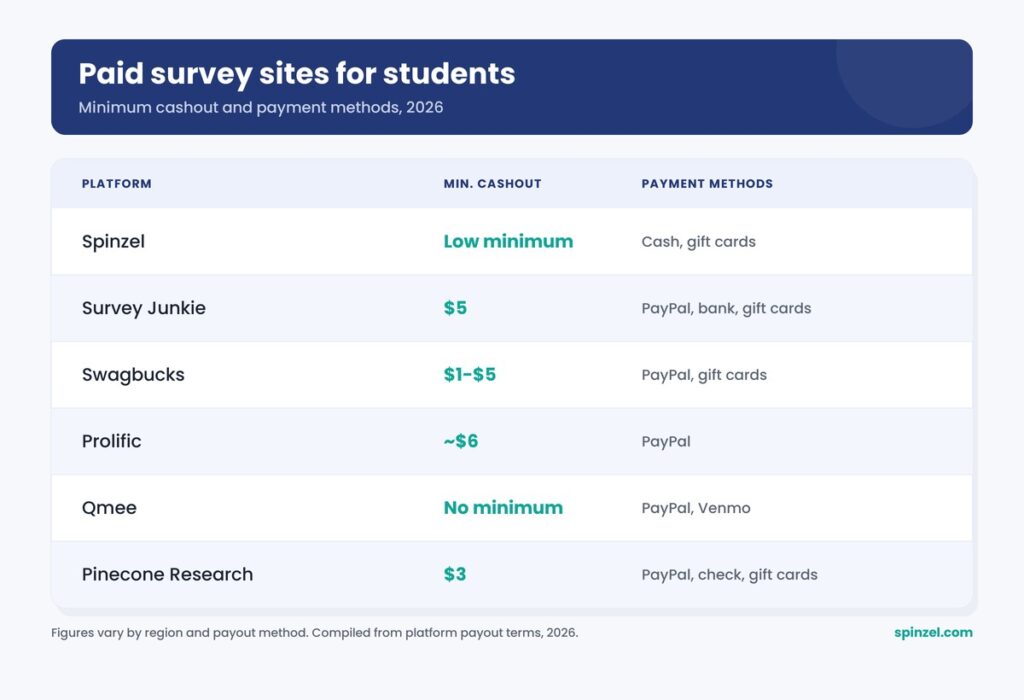
| Platform | Earning model | Minimum cashout | Payment methods | Best for |
| Spinzel | Surveys, reward offers | Low minimum | Cash, gift cards | US students starting out |
| Survey Junkie | Points (100 = $1) | $5 (500 points) | PayPal, bank transfer, gift cards | Beginners |
| Swagbucks | Points (SB) | Gift cards ~1-3; PayPal ~$5 | PayPal, gift cards | Earning beyond surveys |
| Prolific | Research studies | ~$6 | PayPal | Higher per-study pay |
| Branded Surveys | Points (1,000 = $10) | $5 (500 points) | PayPal, direct deposit, gift cards | Daily survey volume |
| Qmee | Cash to PayPal | No minimum | PayPal, Venmo, gift cards | Instant small payouts |
| InboxDollars | Cash | 15-30 (varies) | PayPal, Visa, gift cards, check | Cash payouts |
| Pinecone Research | Flat ~$3/survey | $3 | PayPal, check, gift cards | Consistent per-survey pay |
| YouGov | Points (1,000 = $10) | ~$50 | PayPal, gift cards, prepaid cards | Opinion surveys |
| LifePoints | Points | ~$5 | PayPal, gift cards, charity | Wide country availability |
Spinzel runs paid surveys and reward tasks for US users, with cash or gift card payouts and a low minimum. The surveys available to you depend on which studies are open when you log in.
Sign up: spinzel.com
Survey Junkie offers plain market research surveys on a simple points system, where 100 points equals $1. Once you earn 500 points, you can redeem them for around $5 through PayPal, a bank transfer, or a gift card. The platform accepts users from the US, Canada, and Australia.
Website: surveyjunkie.com
Swagbucks pays for surveys plus videos, shopping, and games, so there is usually something to do when surveys dry up. Gift cards start near $1 to $3, and PayPal cash near $5.
Website: swagbucks.com
Prolific runs academic and research studies and enforces a pay floor of about $8 an hour, well above typical survey rates. Cash out to PayPal starts around $6, and studies fill fast, so it is worth checking in often.
Website: prolific.com
Branded Surveys focuses on consumer research and offers extra points to users who complete surveys regularly. Its $5 cashout minimum is among the lowest around, with solid volume for US, UK, and Canadian members.
Website: surveys.gobranded.com
Qmee has no minimum cashout, so any balance goes straight to PayPal or Venmo within minutes. Surveys pay about $0.40 to $2 each, and the instant payout suits short pockets of free time.
Website: qmee.com
InboxDollars pays you in actual dollars, so there are no points to convert, across surveys, paid emails, and videos. The catch is a higher minimum, reported between $15 and $30 by method, on this mostly US platform.
Website: inboxdollars.com
Pinecone Research is invite-only and owned by Nielsen, paying a flat $3 per survey with no mid-survey screen-outs. The $3 minimum means one survey can cash out, though invites are limited and surveys come 1 to 4 times a month.
Website: pineconeresearch.com
YouGov runs opinion and current-events surveys under a trusted polling name. Points add up slowly. You may need time to reach the $50 cash out limit. Rewards come as gift cards, prepaid cards, or PayPal.
Website: yougov.com
LifePoints offers simple consumer surveys, redeemable for PayPal cash, gift cards, or charity at around $5. Its wide country list helps when US-only panels keep screening you out, and point values can rise during seasonal bonus events.
Website: lifepointspanel.com
Ready to try it? Browse the surveys on Spinzel and start with a couple of short ones to see how it works. There is no fee to join.
When your free time comes in five-minute pieces, pick sites with low or no minimums and fast payouts. Qmee leads here because any balance goes to PayPal the moment you earn it. Google Opinion Rewards works the same way on a phone, for very short surveys.
Prolific is worth keeping open in a browser tab. Its studies pay more per minute when you catch them early. For quick money between classes, Spinzel and other survey apps that pay real money let you answer a few questions without a long session.
College students can earn $20 to $100 a month from online surveys. The extra money helps with small expenses, but it won’t replace a regular income. Your total depends on your profile, how many surveys you qualify for, their length, and which sites you use.
The hourly math is less flattering than the sign-up pages suggest. A typical survey pays $0.50 to $3 for 5 to 20 minutes, which puts points-based sites below minimum wage once you count the surveys you start and get screened out of. Screen-out rates of 20% to 30% are normal, and that time is unpaid.
Prolific and Pinecone are the exceptions, since they pre-match you before you start, so their per-survey rates hold up. Running two or three sites at once is what lifts a slow month, because it raises the odds you qualify for something on any given day.
Short answer: survey earnings are taxable income, but they rarely trigger a tax form or dent your financial aid. Here is what that means for a student.
The IRS treats survey rewards, cash or gift cards alike, as taxable income you are meant to report, even when no form arrives. See the IRS guidance on taxable income. Students rarely receive a form, though.
A payment app like PayPal only issues a 1099-K after you clear $20,000 and 200 transactions in a year, and direct-pay reporting thresholds sit well above what survey-takers earn. At $20 to $100 a month, you are nowhere close.
The same holds for financial aid. On the FAFSA, survey money counts as student income, but the student income protection allowance runs over $11,000 for dependent students, and only income above that line is assessed.
A few hundred dollars a year sits far below it, so your federal aid does not move. You can confirm the current figures on StudentAid.gov. Keeping a simple record of what you earn is still smart, in case your total ever climbs.
A legitimate survey site never charges a fee to join and never asks for bank logins or a payment to see more surveys. That one rule screens out the worst offenders. Beyond it, look for a clear privacy policy, a stated payout threshold, and a payment method you use.
Students get targeted by a specific con: fake “campus rep” or “paid research” offers that arrive by email or social DM, ask for your .edu login or a deposit, and then vanish. Treat any unsolicited high-pay offer as suspect.
Check the company first, since Better Business Bureau ratings and recent user reviews show whether people get paid on time, and the FTC publishes advice on spotting money-making scams that applies directly to survey offers.
The surveys that pay college students best tend to reward active, trusted accounts. A few habits raise how many you get:
Spreading effort across a few sites beats grinding a single panel that rarely has work.
Paid surveys can be safe if you use trusted platforms. Keep your personal information private. Real sites ask for demographic information to match surveys, but they never need your Social Security number, a bank password, or a payment to join.
Two habits keep your data clean.
Treat paid surveys as what they are: small, flexible money that fills the gaps a part-time job cannot. Start with one low-minimum site like Survey Junkie or Qmee, add Prolific for better hourly pay, and keep a mobile option for downtime.
The best paid surveys for college students are the ones that match your schedule and payout, so cash out often and keep expectations tied to the few dollars each survey pays.
Start now with a free Spinzel account. Complete your profile, and you can take your first survey.
There is no single best site. Beginners often start with Survey Junkie for its low $5 cashout, while Prolific pays more per study. Running two or three sites together gives you the steadiest results.
Active survey-takers usually earn $20 to $100 a month, depending on profile, qualification rate, and time spent. Higher-paying sites like Prolific lift the hourly rate, but surveys suit pocket money, not a salary.
Technically, yes, survey earnings are taxable, but students rarely receive a tax form because payout totals stay small. Keep a record of what you earn and report it if your total grows.
Common options are PayPal, gift cards, bank transfer, and prepaid Visa cards. A few sites, like Qmee, send cash with no minimum, while others require $5 to $30 before you can cash out.
They are worth it for small, flexible earnings you can fit around classes. The pay per hour is low, so they work best as a top-up alongside other income, not a main source of money.